Why Your Lead-to-Visit Ratio Stays Low (And What Actually Fixes It)
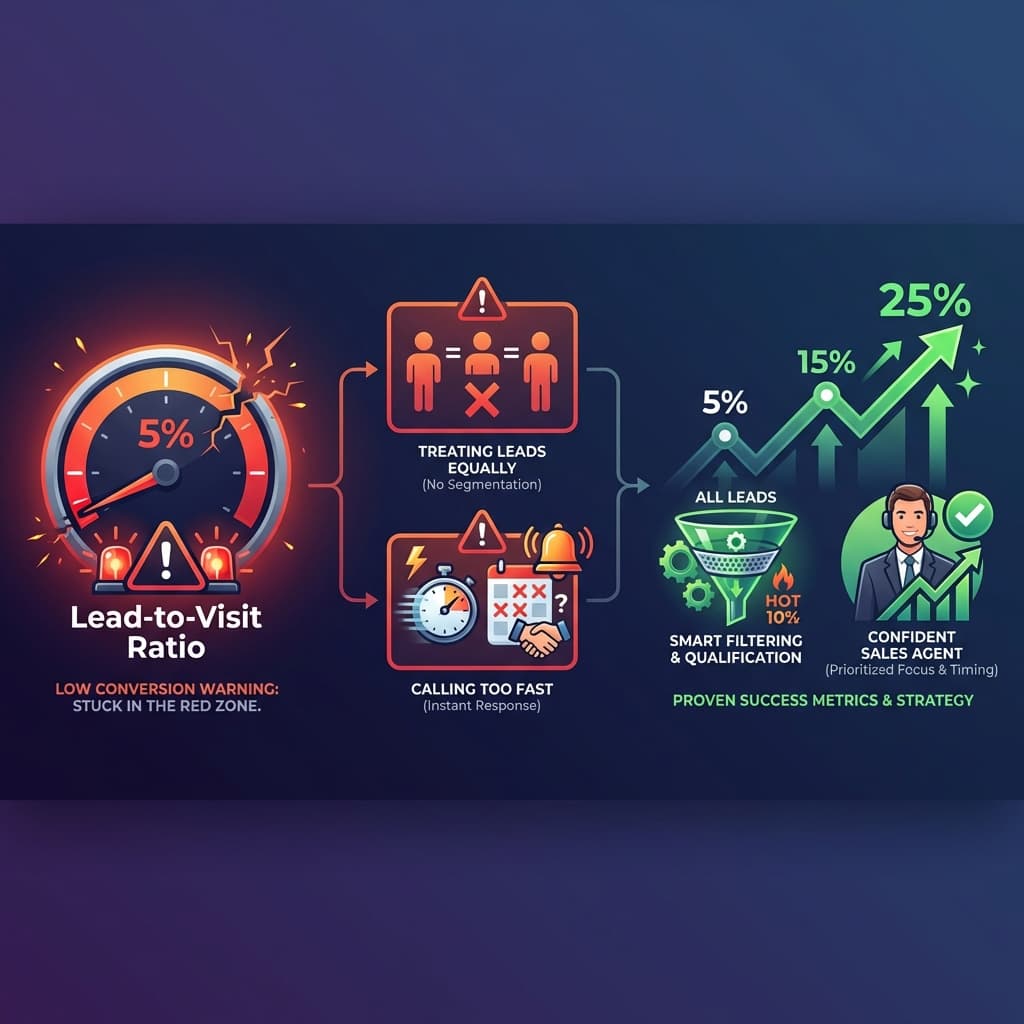
Most real estate leads never visit the site. The gap is not effort and it is not volume. It is a missing layer between what your CRM records and what a buyer does after your rep hangs up. Here is why that Followthrough Gap exists, what it costs you each quarter, and how to close it with buyer intent signals.
Manish heads the sales team for a mid-size residential developer in Coimbatore. Last quarter, his team received 1,400 leads across portals and digital ads. They made calls, sent WhatsApp messages, shared floor-plan PDFs, and followed up on every lead at least three times. Final site visit count: 91. That is a ratio just above 6 percent. Manish knows it should be higher. What he does not know is why it is not.
The answer is not volume and it is not effort. His reps are working. The real issue is that his team is flying blind between conversations. They see what they sent. They cannot see what the buyer did next. That invisible stretch between your last outreach and your next call is what we call the Followthrough Gap, and it is the primary reason lead-to-visit conversion rates stall across almost every residential sales team we work with.
What is the Followthrough Gap?
The Followthrough Gap is the silence between your last outreach and your next call. Inside that silence, buyers are doing real work: revisiting pricing pages, forwarding brochures to a spouse, comparing payment plans, or opening the same document three times in one evening. Your CRM records none of it. Your rep knows none of it. So when they call back, they lead with a generic check-in instead of a specific, contextual conversation.
This gap is not a technology failure. It is a visibility failure. Teams have CRMs, call logs, and dialer tools. What they lack is a layer that watches buyer behavior after the rep hangs up. Without it, every follow-up is a cold guess dressed up as a warm call. The buyer has moved on mentally, completed more research, involved a family member in the decision, and your rep dials in with "just wanted to check if you had any questions." The buyer hears that and concludes you have no idea who they are.
Why does the Followthrough Gap widen as lead volume grows?
When lead volume is low, experienced reps compensate through memory and intuition. They remember that a particular buyer asked twice about the 2BHK on the 8th floor. They follow up with that specific context. Conversion stays reasonable even without structured buyer intent tracking.
At scale, that breaks down. When a rep handles 60 or 80 leads at a time, no one can track which buyer opened the floor plan at 11pm last Tuesday or who forwarded the payment plan PDF to a sibling. The Followthrough Gap grows with every new lead added to the queue. Volume becomes the enemy of quality unless there is a system reading buyer signals on the rep's behalf.
Here is the contrarian truth most sales managers resist: adding reps before closing the Followthrough Gap makes the ratio worse, not better. More reps calling with less context means more buyers who feel pestered by generic outreach. The fastest way to improve lead-to-visit conversion is not to hire, it is to see better.
What buyer intent signals actually predict a site visit?
Not all buyer behavior carries equal weight. Casual browsing looks very different from active evaluation. In deployments we observe, the behaviors that most reliably precede a site visit share three qualities: they are commercial in nature, they are repeated, and they happen close to the follow-up window.
- Returning to the pricing or payment-plan section more than once within 48 hours.
- Sharing a microsite or brochure link with a second device or a new contact.
- Spending time on possession date, legal, or ownership-structure pages.
- Opening a booking or scheduling link without completing it.
- Reviewing floor-plan details after a call that felt flat or non-committal.
- Session sequences that move from project overview toward unit-specific pages.
- Downloading the cost sheet or loan eligibility calculator during evening hours.
A rep who knows that a buyer returned to the payment-plan page twice yesterday can open a call with: "I noticed you were looking at the installment structure again. Do you want me to walk you through how other buyers in your bracket are handling the down payment?" That is not a pitch. It is a consultation. And consultations convert. The same lead receiving a generic "just checking in" call will move further from a visit, not closer.
How does the Followthrough Gap show up in daily operations?
It shows up as three patterns that managers often misread as people problems rather than information problems.
First: reps call every lead in queue order, not in intent order. The buyer who opened the brochure four times yesterday gets the same priority as the buyer who has not touched any content in two weeks. Both receive the same script. One is ready. One is not. The rep cannot tell which is which.
Second: follow-up messages are generic. When reps cannot see what the buyer did, they cannot reference it. They default to "just checking in" language. That phrasing signals to the buyer that your team has no idea where they are in their decision. It raises doubt instead of trust.
Third: high-intent buyers fall through the cracks during busy periods. A lead who showed serious engagement on a Friday afternoon may not receive a contextual call until Monday. By then, a competitor who happened to call at the right moment has booked the visit.
Rule Outreach volume vs. followthrough visibility
More calls into the Followthrough Gap produce more noise. Calls informed by buyer behavior inside that gap produce site visits.
Operator scenario: the weekend-window problem
Consider Priya, a sales manager for a plotted-development project outside Nashik. Her project attracts buyers who work long weeks and do their property research between Friday evening and Sunday afternoon. Portal inquiries spike on Saturday mornings. Her rep team works Monday through Saturday, but Monday morning is spent clearing administrative backlog first.
By the time a rep calls a Saturday-morning inquiry with any real attention, it is Tuesday afternoon. The buyer spent Sunday evening on three competitor microsites, forwarded two brochures to a parent, and is now in a WhatsApp group with siblings discussing a different project entirely. The Followthrough Gap here is not 24 hours. It is 72 hours of unmonitored buyer behavior during the exact window when the buyer is most engaged.
Priya's solution was not to roster weekend staff for cold calling. It was to instrument her microsites and brochure links so that Monday morning surfaces a ranked list: which Saturday leads showed strong engagement over the weekend, what they viewed, and in what sequence. Reps arrive Monday with a short list of warm conversations, not a long queue of identical check-ins. The lead-to-visit ratio for the plotted-development project improved noticeably within two sales cycles because the first call after each weekend was contextual rather than generic.
Operator scenario: the co-decision-maker blind spot
Vikram manages a luxury apartment project in Hyderabad where the average ticket size means nearly every purchase involves two decision-makers: often a couple, sometimes an adult child and a parent. His reps have detailed conversations with the primary contact but have no visibility into what happens when that person shares the project materials with the co-decision-maker.
In practice, the share event itself is one of the strongest buying signals in the funnel. When a buyer forwards a microsite link to a new contact, they are not just passing along information. They are inviting someone else to evaluate. A conversation is happening between those two people right now, and your rep is not in it. If the co-decision-maker visits the microsite and spends time on the legal and possession sections, the purchase discussion has moved to a serious phase.
Vikram's reps were trained to treat any share event as a trigger for a same-day call. The opening: "I saw you shared the project details with someone. Happy to set up a call that includes them, or answer any questions they might have come back to you with." That single change in call-opening logic produced a measurable lift in visits from the luxury segment, because it acknowledged the real decision structure instead of pretending the sale was a single-buyer conversation.
The "effort theater" anti-pattern
There is a named failure mode worth calling out directly: effort theater. This is when a sales team optimizes for activity metrics rather than outcome metrics. Call count is up. WhatsApp messages sent is up. Follow-up rate hits 100 percent. Lead-to-visit ratio stays flat or declines.
Effort theater happens when the visible work of outreach becomes the goal rather than the means. Managers reward reps for call volume. Reps respond rationally by making more calls with less preparation. Buyers receive more contacts that feel less relevant. Over time, the buyers who were genuinely interested but not yet ready become actively resistant because the cadence felt intrusive rather than helpful.
The diagnostic for effort theater is simple: pull the last 30 days of calls and ask what percentage opened with a buyer-specific reference. If more than half opened with a variation of "just checking in" or "wanted to follow up on my previous message," the team is running effort theater. The fix is not a new script. It is buyer visibility. Reps cannot personalize calls they have no context for. Closing the Followthrough Gap is what makes effort theater structurally impossible, because every call gets pre-loaded with something specific.
How to operationalize intent-signal routing in a real sales workflow
Closing the Followthrough Gap is not a project that takes months. The operational change has four components and can be stood up inside a single sales cycle.
Component one is signal instrumentation. Every buyer touchpoint that leaves your team's hands needs to be tracked: microsites, brochure links, floor-plan PDFs, cost sheets, and payment-plan documents. These are not just collateral. They are behavioral windows. Each document and page becomes a signal source.
Component two is intent scoring. Not all signals are equal. A single page view carries less weight than a return visit to a commercial page. A share event carries more weight than a long session on the overview page. Scoring lets your system surface the leads with genuine purchase momentum rather than treating all activity as equivalent.
Component three is priority routing. Each morning, reps receive a ranked list of leads ordered by recent intent activity. Leads with high-priority signals, such as return visits to pricing, share events, or incomplete booking link clicks, appear at the top. Reps start with those calls, every day, before touching the standard queue.
Component four is context delivery. The signal data needs to be in the rep's hands before the call, not after. A short brief: what the buyer viewed, when, how long, and what section they stopped on. This is the material the rep uses to open the call with specificity. No preparation time required beyond reading a two-line summary.
When these four components are in place, the Followthrough Gap closes operationally. Buyers who are in active evaluation receive contextual calls at the right moment. Buyers who are cold receive lighter nurture until they show renewed activity. The overall ratio improves because the allocation of rep effort shifts from equal-distribution to intent-weighted.
What does a team look like when it closes the gap?
Reps begin each morning with a ranked list. At the top: buyers who showed commercial intent in the last 12 to 24 hours. These are the first calls of the day, and they happen before the rep has looked at anything else. The context comes pre-loaded: what the buyer viewed, when, how many times, and what section they stopped on.
Mid-queue leads receive messages that reference their actual behavior. Not "just following up" but "you spent some time on the 3BHK plans last evening. I wanted to share a short note comparing the two towers." The buyer feels known. That feeling reduces resistance.
Cold leads, those who have not engaged with any content, get placed into a slower nurture sequence rather than receiving daily calls that waste rep time and irritate the buyer. Resources flow toward the leads most likely to visit. This is not a soft optimization. It is a structural reallocation of the most constrained resource in any sales team: experienced rep attention.
What changes after a quarter of working this way?
The most immediate change is the conversation quality. Reps stop apologizing for calling again and start opening with specific, relevant context. Buyers who felt pestered begin to feel assisted. That shift alone moves conversion because trust is the primary driver of a site visit decision, especially in high-ticket residential real estate where a buyer is committing savings that took years to accumulate.
Over a full quarter, pipeline clarity improves. Managers can see which leads are genuinely active evaluators, which are stalled, and which were never going to visit regardless of how many times the team called. That visibility makes forecast conversations honest and makes coaching conversations specific. Instead of "you need to close more," a manager can say "these six leads showed strong signals last week and did not get a contextual first call. That is the gap."
Teams also discover a counterintuitive result: fewer total outreach touches, higher total site visits. Because effort concentrates on the buyers who are ready, the ratio improves even if raw call volume drops. In teams using intent-signal routing, the lead-to-visit ratio typically climbs as reps stop burning capacity on low-readiness leads.
A subtler shift happens in team morale. Reps who spend most of their day being rejected by unready buyers develop a defensive, low-energy call style. Reps who spend their day opening conversations they already have context for develop confidence. The call feels like a service rather than an interruption. That energy is perceptible to buyers and it affects conversion in ways that no script change ever fully captures.
The deeper bet: Manish is not losing to better competitors
Back to Manish in Coimbatore. His 6 percent ratio is not a recruitment problem or a script problem. It is a Followthrough Gap problem. Somewhere in those 1,400 leads, there are buyers who opened his project pages multiple times, forwarded unit details to a spouse, and checked possession dates. His reps never knew. So those buyers heard a generic check-in call at the wrong moment, felt unimpressed, and booked a visit with a developer whose rep happened to reach out when the intent was visible.
His competitors did not outwork him. They did not out-script him. They were simply informed at the moment Manish's team was guessing. The Followthrough Gap is not a talent problem or a training problem. It is an information problem. And information problems have information solutions.
The deeper bet here is not about technology. It is about what information a sales team deserves to have before they make a call. Buyers are spending real time with your content. They are making real decisions in the Followthrough Gap. The question is whether your team is informed when they dial in, or guessing.
How much is the Followthrough Gap costing your pipeline?
Brixi surfaces buyer intent signals from every touchpoint so your reps call with context, not guesswork. See which leads are in active evaluation right now.
Explore the buyer intent engineFrequently Asked Questions
It varies significantly by lead source. Portal leads tend to convert at a higher rate than broad digital ad leads because the buyer has already shown search intent. Most teams working without intent tracking land in the 5 to 10 percent range across sources. Teams that route follow-ups based on buyer behavior signals typically see that number improve meaningfully within a quarter, because effort concentrates on the leads who are actively evaluating rather than the full funnel.
A CRM gap usually refers to missing data about your own team's outreach: calls not logged, notes not updated, deals not moved through stages. The Followthrough Gap is different. It is the absence of data about what the buyer does between your contacts. Even a perfectly maintained CRM cannot show you that a buyer returned to the pricing page three times after your last call. Closing the Followthrough Gap requires a buyer-side intent signal layer, not just better CRM hygiene.
Yes, in most cases. A lead who has not interacted with any content in 10 or more days is not ready for a daily call campaign. Continuing to call at high frequency frustrates the buyer, wastes rep time, and can permanently close the conversation. A better approach is to move low-engagement leads into a lighter nurture sequence, then trigger a direct call when they show renewed activity. That way the call is timely and the rep has context for it.
The highest-priority signals are those combining commercial intent with recency and repetition. A buyer who revisits the payment plan or pricing section twice in a single evening, or who opens a booking link without completing it, is in an active decision window. A buyer who shares the microsite with a new contact is bringing in a co-decision-maker, which means a conversation is happening right now without your team in it. Both patterns warrant a same-day call with specific context about what the buyer was reviewing.