The Conversations That Close Deals Are the Ones You Never Captured
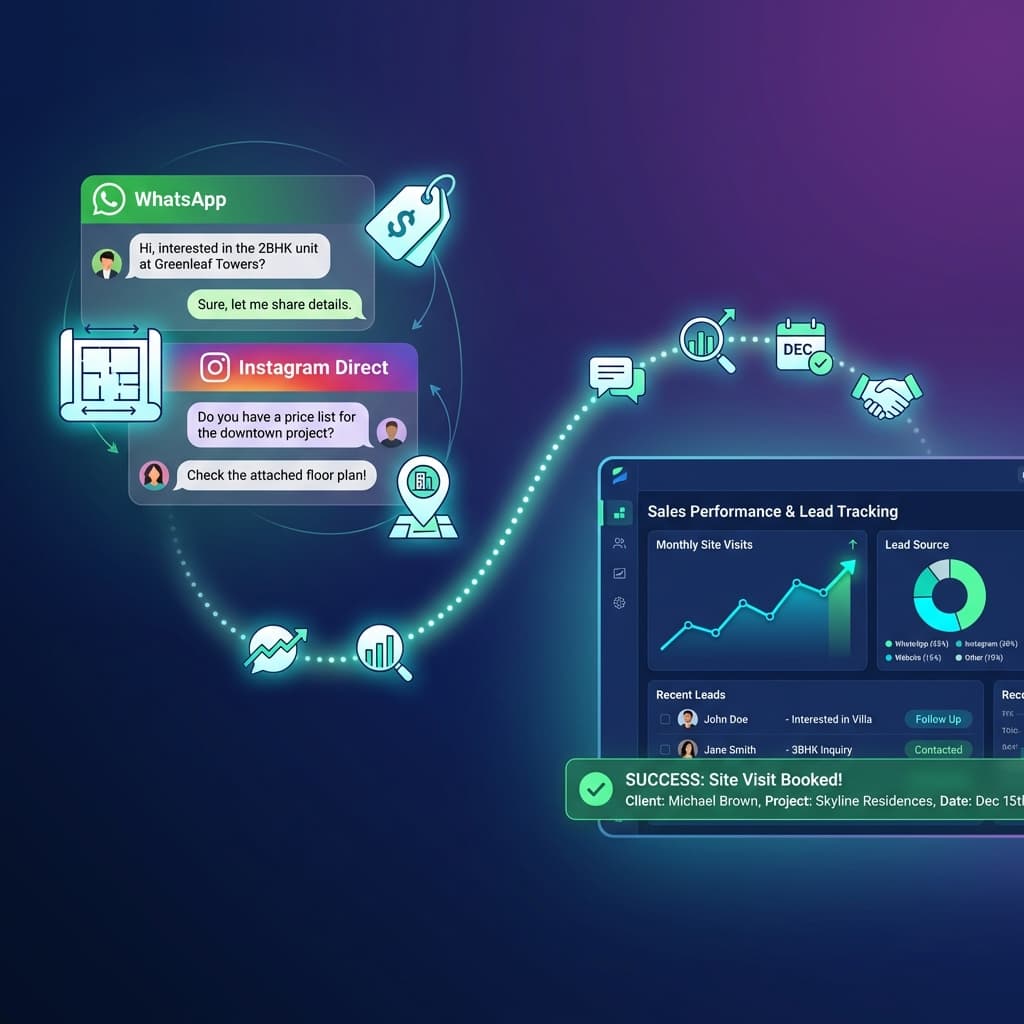
Indian sales teams have a capture problem, not a tracking problem. Hundreds of high-intent conversations happen every week across WhatsApp, calls, and site visits, and almost none of them become structured records that a rep can act on the next morning.
At 11:04pm on a Tuesday, a buyer replied to a WhatsApp message your rep had sent three days earlier. The message was four sentences: a question about the floor plan, a mention that the family had narrowed it down to two projects, and a request to speak with someone senior before the weekend. By the time your rep opened WhatsApp at 9:15am on Wednesday, the buyer had already visited the competing project at 10am that morning. The deal was over before the working day began. Nothing in your CRM recorded what happened.
That is not a story about buyer intent signals. It is a story about a conversation that happened and evaporated. It was high-intent, it was time-sensitive, and it was completely invisible to the sales process. The problem was not that the team failed to track behavior. The problem was that the conversation was never captured into anything a rep could act on.
What is the real gap in how Indian sales teams operate?
There is a widespread belief in sales operations that the core problem is attribution: which touchpoints influenced a deal, which rep activity moved a prospect forward. Entire CRM configurations are built around logging calls, tagging lead stages, and scoring activity. That belief is not wrong, but it is incomplete in a way that costs teams deals every week.
The more fundamental problem is capture. Before you can track a conversation, it has to exist as a record. Before you can analyze intent, you need the words. And in most Indian sales environments, the actual substance of conversations, what a buyer said, what objection they raised, what commitment they made, disappears the moment the call ends or the chat window closes. What survives is a rep's memory and, if you are lucky, a two-word CRM note that says "interested, follow up next week."
This is the Evaporation Problem. Not a gap in visibility into buyer behavior. A gap between conversations happening and conversations becoming revenue-bearing records.
Why does conversation evaporation happen even when teams are trying hard?
Sales reps in real estate, SMB, and high-ticket B2B handle somewhere between twenty and sixty active leads at any given time, often more during a campaign period. After each call, the rep is typically moving to the next one within minutes. The cognitive overhead of converting a ten-minute conversation into a structured CRM record is real, and it is friction that compounds across a team of ten or twenty people.
WhatsApp makes this worse because it does not feel like a formal channel. A rep replies to a buyer's question from their personal phone, handles a negotiation over voice notes, and shares a payment plan PDF in the same thread where they sent a festival greeting two weeks ago. None of this is designed to flow into a CRM. It is designed for human conversation. The result is a parallel communication channel that carries some of your most critical deal information and is structurally disconnected from every system your sales manager reviews.
Voice calls have the same problem from a different angle. A forty-minute site visit follow-up call between a rep and a serious buyer might surface three specific objections, a revealed budget ceiling, a preferred possession quarter, and an admission that a spouse is the primary decision-maker. Almost none of that becomes a searchable record. The rep may remember the headline. The texture of the conversation, the part that would help the next rep or help the manager coach the deal, evaporates.
Is the argument really just "log your calls better"?
No, and this is worth arguing directly. The standard response to conversation evaporation is process: mandate call notes, build a logging checklist, add a CRM field for "key objection." That approach has been tried in nearly every organized sales team and it consistently fails at scale for a simple reason. The person doing the capturing is the same person doing the selling, and selling is always the higher-priority task.
The contrarian claim here is this: conversation capture cannot be a rep behavior. It has to be an infrastructure behavior. The system has to capture the conversation automatically, then surface the structured output to the rep, not ask the rep to produce the structured output and hand it to the system. When that inversion happens, capture rates do not improve marginally. They change categorically. A rep who receives a summary of their last call with a tagged objection and a suggested next step behaves differently from a rep staring at a blank CRM note field after their tenth call of the day.
What does a conversation look like after it has been captured properly?
A captured conversation is not a transcript. A transcript is a document that requires human processing to become useful. A properly captured conversation is structured output: which lead was involved, what stage the deal is at, what the buyer said that indicates intent or hesitation, what the rep committed to doing next, and what signals suggest the timing of the next outreach.
That structured output is the thing that makes a conversation revenue-bearing. It is what allows a manager to review pipeline based on what buyers actually said, not what reps chose to type. It is what allows a voice AI agent to pick up a follow-up call with the right context, because the previous conversation was structured and available. It is what makes a WhatsApp automation feel relevant rather than generic, because the message sent on Wednesday morning references the specific concern the buyer raised on Sunday evening.
Rule The Evaporation Problem
A conversation that is not captured is not just untracked. It is gone. The buyer's exact words, their real objection, their revealed budget, their timeline, none of it exists in any form the business can act on. Capture is not a CRM feature. It is the precondition for everything else in sales intelligence.
How does the Evaporation Problem show up differently across sales channels?
In real estate, the highest-value conversations often happen at site visits, over tea, while a buyer is standing in a half-finished apartment looking at the view. Reps in that moment are not taking notes. They are reading the room and making the human connection that moves a deal. That conversation, which may contain a buyer's revealed price anchor or their emotional attachment to a specific unit, lives only in the rep's memory for the next forty-eight hours, then fades.
In SMB sales, the evaporation problem plays out across repeated short calls where each conversation moves the deal forward incrementally but no single call produces a CRM update. By the time the deal closes or falls apart, the sequence of conversations that led there is mostly unrecoverable. Post-mortems on lost deals become speculation because the data is not there.
In WhatsApp-heavy sales environments, which is most of India, the problem is compounded by fragmentation. A buyer's conversation is split across the rep's personal WhatsApp, the company WhatsApp Business number, and sometimes a team inbox. Reconstructing what was said, when, and by whom requires manual effort that almost never happens. The most recent message is visible. The history is technically present but practically inaccessible for sales decision-making.
What does fixing this actually require?
- Call recording and transcription that runs automatically, without rep action, and syncs to the lead record by default.
- WhatsApp conversation threading that connects a buyer's messages across time into a unified view attached to a CRM contact.
- Voice AI agents on follow-up calls that are briefed from prior conversation summaries, not from a rep's last CRM note.
- Structured objection tagging that extracts buyer concerns from conversation text and surfaces them in the pipeline view, not buried in a transcript.
- Automated next-step suggestions derived from conversation content, so the rep's action list is built from what the buyer said, not from a manual follow-up process.
None of these require reps to change how they have conversations. That is the point. The capture layer sits below the conversation, not inside it. Reps keep selling the way they sell. The system captures what they cannot afford to stop and type.
What changes in a sales team once conversations stop evaporating?
The first and most immediate change is follow-up quality. When a rep prepares for a call using a summary of the previous conversation, including the buyer's exact concern about parking allocation or possession delay risk, the call opens differently. It is specific, it is relevant, and it demonstrates that the previous conversation was heard. Buyers in high-ticket categories respond to that quality of engagement in a way that generic check-ins cannot produce.
The second change is pipeline accuracy. A pipeline built on captured conversations reflects what buyers are actually doing and saying. Leads that look active based on rep outreach but have expressed clear hesitation in calls show up differently from leads that sound quiet in the CRM but have repeatedly asked specific questions about possession dates. Managers can prioritize coaching and attention based on real deal signals, not rep-reported stage labels.
The third change is institutional learning. When conversations are captured, the team builds a searchable record of how deals actually close. What language worked when a buyer raised a financial concern? Which objection most often appeared two calls before a site visit? What question sequence led to a booking decision? That knowledge currently lives in the heads of your best reps and leaves when they do. Captured conversations make it structural.
The 11pm WhatsApp reply that decided a deal is the everyday version of this problem. It is not exceptional. It is representative of the hundreds of high-intent moments that happen across a sales team in a week and disappear before the working day begins. Fixing it is not a technology bet. It is a decision about what a business treats as worth knowing.
How many revenue-bearing conversations did your team lose this week?
Brixi captures conversations across calls, WhatsApp, and voice AI interactions, then structures them into pipeline signals your team can actually act on.
Explore the buyer intent engineFrequently Asked Questions
Conversation capture is the automatic conversion of sales conversations, across calls, WhatsApp, and voice interactions, into structured records that a CRM or sales tool can act on. It matters because most sales teams lose the actual substance of buyer conversations to memory and informal channels. A buyer's real objection, revealed budget, or timeline preference rarely makes it into a CRM note. Capture infrastructure changes that by extracting and structuring conversation content without requiring rep effort.
Because logging is a competing demand on the same person doing the selling. After ten calls in a day, the cognitive cost of converting each conversation into a structured CRM entry is high enough that most reps default to minimal notes or skip the step entirely. This is not a discipline problem. It is a design problem. Systems that require humans to produce structured output from unstructured conversations at scale will consistently underperform systems that capture automatically and present structured output to the human afterward.
Integration between WhatsApp Business and a CRM typically works through the WhatsApp Business API, which allows messages to be routed through a platform that can thread them by contact and attach them to a lead record. This is different from a rep's personal WhatsApp, which has no API access. Teams that shift high-intent buyer communication to a WhatsApp Business number connected to their CRM platform can capture message history, link it to the correct lead, and surface it alongside call records and content engagement signals.
Technically yes, but practically they perform much closer to a cold call than a warm follow-up, which undermines the purpose of using them for lead nurturing. Voice AI agents that are briefed from captured and structured previous conversations, knowing what objection the buyer raised last time and what the rep committed to, can have a different quality of conversation. The capture layer is what makes AI-assisted follow-up feel relevant rather than generic. Without it, AI handles the mechanics of a call but not the relationship continuity that moves a deal forward.