Why Calling Every Lead Kills Your Conversion Rate
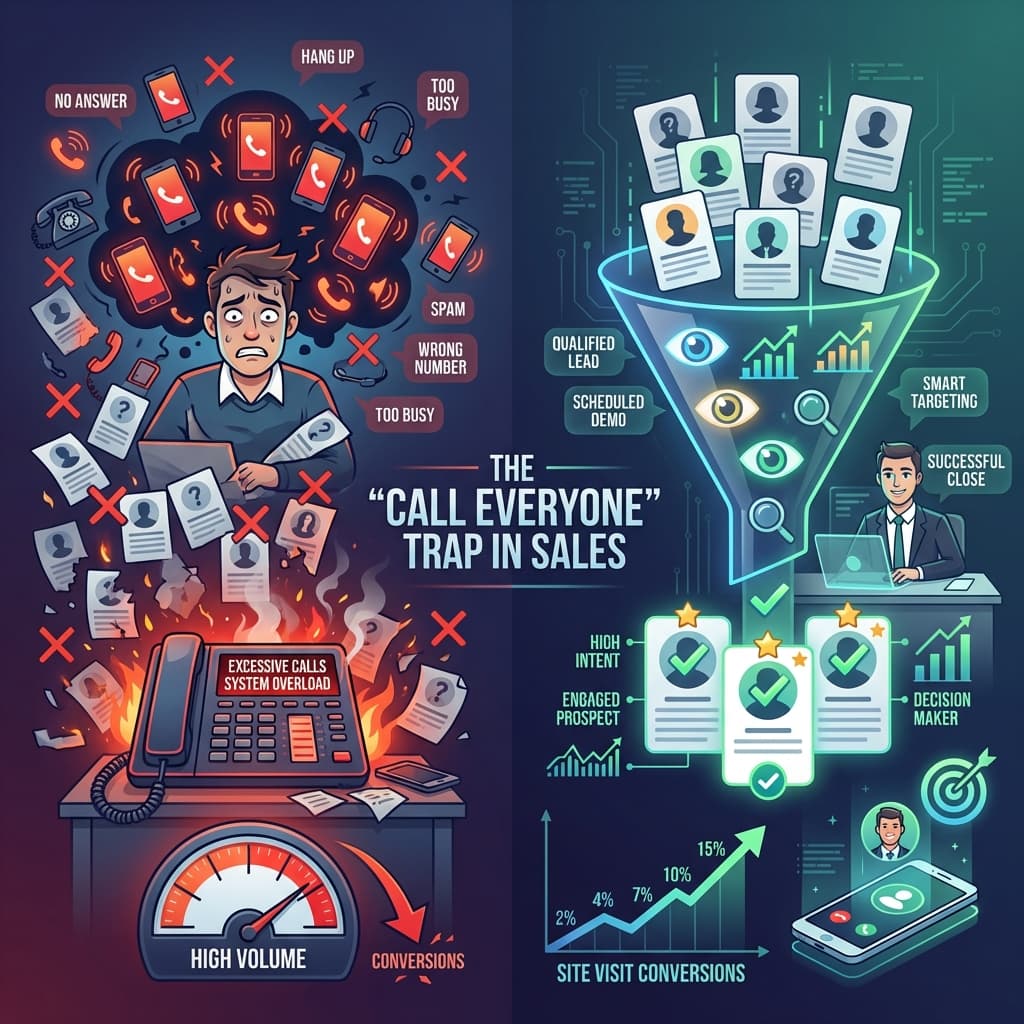
High call volume feels productive but it burns your best leads. When every inquiry gets the same follow-up cadence, buyers who are almost ready get the same treatment as browsers who were never serious.
Sneha manages a 12-person sales floor for a Mumbai residential developer. Last quarter she pulled the numbers on her team's best month: 2,400 calls made, 41 site visits booked. She assumed the ratio was a volume problem, so she pushed the team harder in the following month. They made 2,900 calls. Visits dropped to 34. She spent two weeks trying to explain the slide to her founder before a junior rep said the quiet part aloud: "We kept calling people who already went cold while the hot ones waited in the queue."
That is the trap. The team was not lazy. They were systematically calling the wrong people at the wrong time, and doing it faster every month.
What is the Flat Cadence Problem?
The Flat Cadence Problem occurs when every lead in a pipeline receives the same follow-up sequence regardless of how they are actually behaving. Lead comes in, rep calls day one, calls day three, sends a brochure on day five, calls again on day seven. The cadence is neat on paper and disastrous in practice, because it treats a buyer who has already read the pricing page three times the same as someone who filled in a form by accident.
In a flat cadence world, timing is determined by a spreadsheet, not by the buyer. The rep who reaches a high-intent buyer on day seven is not skilled, just lucky. The rep who reaches that same buyer on day two because the system flagged repeat pricing-page visits is operating on information. These are different businesses, even if they look the same from the outside.
Why does high call volume make the Flat Cadence Problem worse?
Volume pressure accelerates the problem in two ways. First, it forces reps to spend less time on each call, which means they cannot have the kind of contextual conversation that moves a serious buyer toward a site visit. Second, it fills the working day with low-value contacts, leaving no bandwidth for the genuine follow-through a hot lead actually needs.
There is also a buyer-side cost. A lead who has already decided they are interested does not want to receive three identical check-in calls. Each repeated generic call signals that the developer has not paid attention. That signal is a reason to look elsewhere. Some of the best leads are lost not because a competitor offered a better price, but because a competitor called with context while your team called with a script.
What does buyer behavior actually look like before a site visit?
Buyers who are close to booking a site visit tend to concentrate their attention on a narrow set of decision-relevant content. They revisit pricing. They look at floor plans and unit availability. They check possession timelines. They share links with a spouse or parent. This behavior is clustered and purposeful, unlike the broad browsing of someone who is still in the awareness phase.
The problem is that most teams have no visibility into this activity. A rep might know that a lead was sent a brochure 10 days ago and has not called back. But they have no idea whether that brochure was opened once and forgotten or opened 11 times and shared across a family WhatsApp group. These are radically different situations that call for radically different responses.
- Repeated visits to pricing and payment plan pages within a short window.
- Section-by-section progression from overview to possession and legal terms.
- A second device or new session starting shortly after the first, suggesting the link was shared.
- Clicking on a site visit booking link even without completing the form.
- Return visits within 24 to 48 hours after an initial discovery call.
- Time spent on floor plan or unit configuration sections specifically.
How does the Flat Cadence Problem show up in pipeline reviews?
In most pipeline reviews, every lead in a given stage looks identical. There is a name, a phone number, a date of last contact, and a status like "follow-up pending." That is all activity data. It says what the rep did. It says nothing about what the buyer did.
Managers reviewing this pipeline have no basis for saying lead A is more likely to convert than lead B. So they default to pushing higher volume and faster cadence, which is the only lever they can see. The Flat Cadence Problem is not just a rep-level issue. It is a structural blindspot baked into how most pipelines are reviewed.
Rule Activity data vs. intent data
CRM activity data tells you what your rep did. Buyer intent data tells you what the buyer is doing. Managing a pipeline with only one side of that equation is like navigating with a map that only shows your own car.
How do you break out of the Flat Cadence Problem?
The fix is not to call less. It is to call differently. Specifically, it is to make the timing and content of each call a function of what the buyer has done since the last contact, not a function of how many days have passed since the first inquiry.
This requires three things. First, you need a way to track what buyers do with the content you send them, whether that is a microsite, a brochure, a payment plan PDF, or a booking link. Second, you need a scoring or prioritization layer that surfaces leads whose behavior has changed recently. Third, your reps need to know what the buyer reviewed before they dial, so the call can reference something real.
- Replace queue-order calling with behavior-ranked call lists updated daily or intraday.
- Send content through a trackable channel rather than static email attachments.
- Brief reps before each call with the last three buyer actions, not just the last call date.
- Build two distinct follow-up tracks: one for high-activity leads, one for nurture.
- Flag leads that have gone quiet for more than seven days but had high engagement earlier.
- Review conversion outcomes weekly by call-timing context, not just by call volume.
What changes after a quarter of intent-led calling?
Teams that shift from flat cadence to intent-led prioritization typically see the same or lower call volume but higher site visit bookings within the first quarter. The mechanism is straightforward: reps are reaching buyers when those buyers are actively thinking about the project, so conversations go deeper and objections surface and get resolved rather than leading to polite deferrals.
There is also a secondary effect on rep morale and skill development. When calls are informed by real context, reps stop feeling like they are cold-calling a list. They have something to say. Buyers respond differently to a rep who opens with "I noticed you looked at the two-bedroom pricing a couple of times this week" versus one who opens with "I am just following up on the inquiry you made." The first call feels like a conversation. The second feels like a task.
Managers gain visibility too. When the pipeline is ranked by buyer behavior, pipeline reviews become strategic rather than just motivational. The conversation shifts from "we need more calls" to "these five leads are showing strong signals, what is the plan for each of them this week."
What is the deeper bet Sneha was actually making?
When Sneha pushed her team to make more calls after the first bad month, she was making an implicit bet: that the conversion problem was a reach problem, not a timing or relevance problem. That bet was wrong, and the data showed it within 30 days.
The real bet worth making is that buyers who are close to a decision will give you the information you need to reach them at the right moment, if you are set up to see it. Most developers are not set up to see it. They are set up to count calls, not to read signals. Changing that setup is a structural decision, not a motivation problem. And it is the one change that compounds: every new lead that comes in gets smarter treatment because the system learns what good timing looks like in your specific market and project.
Volume is not the enemy. Blind volume is. The teams that win in high-competition residential sales are not the ones making the most calls. They are the ones whose calls land at the right moment with the right context, because they built a system that can tell the difference between a browser and a buyer.
Is your team still working off a flat call cadence?
Brixi's buyer intent engine ranks your pipeline by real buyer behavior so your reps call the right lead at the right moment, every day.
Explore the intent-powered pipelineFrequently Asked Questions
Queue-order calling treats a lead who has revisited pricing three times the same as a lead who has not opened your message once. High-intent buyers end up waiting while your reps work through cold contacts ahead of them. By the time those buyers get a call, they may have already made a decision elsewhere. Prioritizing by behavior means your best opportunities get attention first.
The Flat Cadence Problem occurs when every lead receives the same follow-up sequence regardless of their actual engagement level. You can spot it by looking at your follow-up process: if the timing of every call is driven by days-since-inquiry rather than by anything the buyer has done, you have a flat cadence. The clearest symptom is high call volume paired with stagnant or declining site visit conversion.
The most reliable signals are concentrated, purposeful engagement with decision-relevant content. Specifically: multiple visits to pricing or payment plan sections within a short window, progression from overview content through to possession timelines or legal terms, sharing behavior where a second session starts from a different device, and return visits within 24 to 48 hours after a direct conversation. These patterns indicate a buyer who is actively evaluating, not just browsing.
Not necessarily fewer, but differently timed. In practice, most teams find that intent-led prioritization shifts effort away from cold re-engagement and toward leads that are already warm. Total call volume may stay similar, but the proportion of calls that lead to a meaningful conversation increases. The goal is not to reduce effort but to redirect it toward moments when the buyer is actually ready to engage.