Why Round-Robin Lead Distribution Kills Real Estate Sales
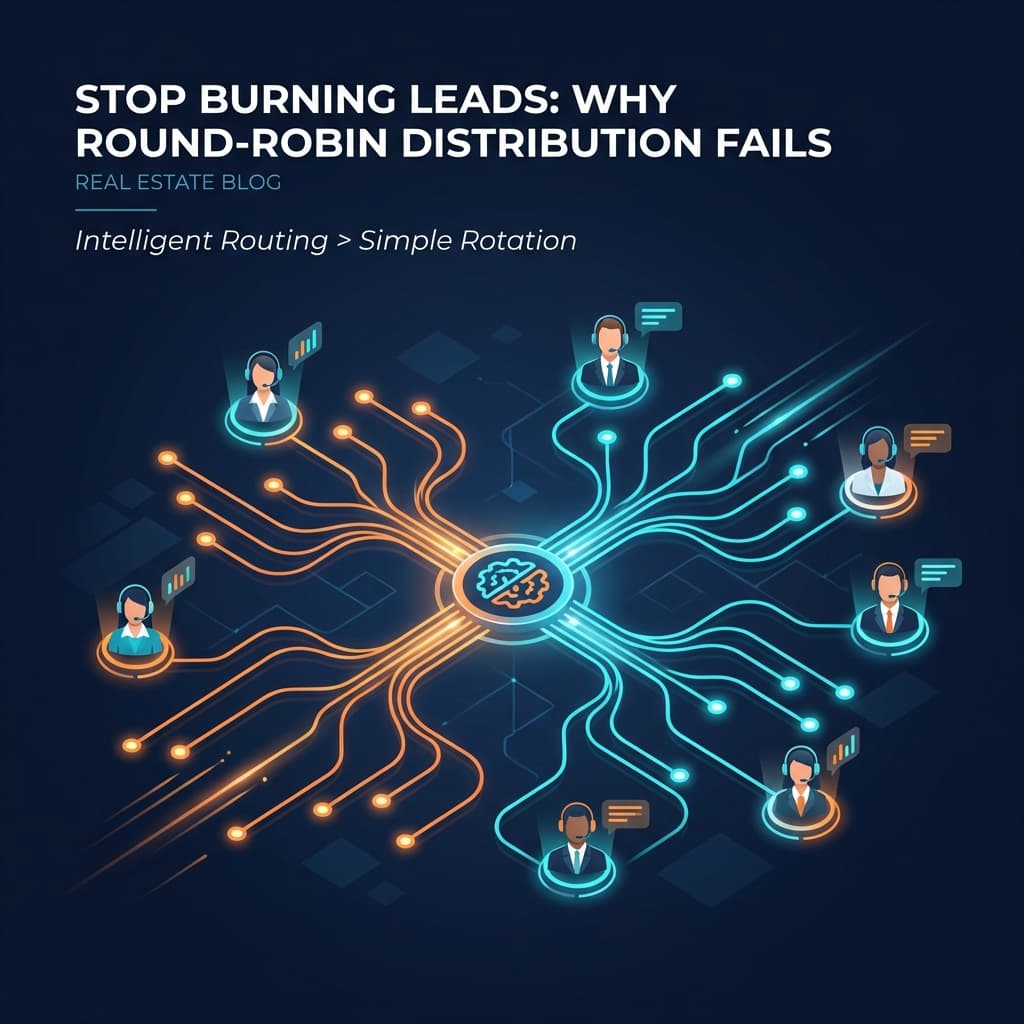
Equal lead distribution sounds fair. In practice, it sends high-intent buyers to your weakest closers and buries urgent leads under a queue. Here is why performance-based routing changes outcomes and how to build it without overhauling your stack.
Rohit manages a 14-person sales team for a Hyderabad developer. Last quarter, one of his senior reps, Pallavi, closed six units. A junior rep two seats away closed one. Both received the same leads, in the same order, through the same round-robin queue. Pallavi spent her evenings on high-intent leads. The junior spent his on people who had not yet decided whether to buy in Hyderabad at all.
Rohit knew the imbalance existed. What he did not know was that it was built directly into his CRM settings. The tool that was supposed to run his pipeline was the reason his best closer was outpaced by her own calendar.
What is the Distribution Trap?
The Distribution Trap is what happens when a CRM assigns leads on strict rotation, treating a buyer who has visited a microsite three times and downloaded a payment plan the same as a buyer who clicked a Facebook ad by accident. Equality looks fair on a dashboard. On the ground, it means your sharpest closer spends 40 percent of her day qualifying cold inquiries, while your most urgent buyers sit in a junior rep's queue.
The Distribution Trap is not a technology failure. It is a design choice baked into most default CRM configurations. Round-robin logic was designed for inside sales teams selling a homogenous product at a fixed price point. Real estate is the opposite: each unit is a large, complex, emotional decision. The buyer who re-reads floor plans at 11pm on a Tuesday is not the same as the buyer who clicked your ad during a lunch scroll.
Why does round-robin survive so long in real estate?
Three reasons keep the Distribution Trap in place even after teams notice the problem.
- Fairness pressure from the team: junior reps push back hard against any system that gives senior reps first pick. Round-robin feels politically neutral.
- CRM defaults: most popular CRM tools ship with round-robin as the standard assignment rule because it requires no configuration.
- Invisible cost: when a high-intent lead books with a competitor after sitting in a queue for three hours, it does not appear on any report as a distribution failure. It looks like a cold lead that went nowhere.
The invisible cost is the dangerous part. Teams measure the leads they close. They rarely measure the leads that were ready to close but were assigned to someone who did not call for four hours because they were still working yesterday's queue.
What signals actually separate a ready buyer from a browsing one?
Not all signals are equal. Filling out a contact form is table stakes. What separates a genuinely high-intent buyer is a cluster of behaviors that show active evaluation, not passive curiosity.
- Multiple visits to a pricing or payment-plan page within 48 hours.
- Opening a brochure or cost sheet more than once, especially from a mobile device late in the evening.
- Sharing a microsite or project page with another person (spouse, parent, financial advisor).
- Clicking a site-visit booking link even without completing the booking.
- Returning to a conversation thread after going silent for several days.
- Spending time on possession date, legal, or registration sections.
A buyer who does two or three of these things in the same week is telling you something without saying a word. A round-robin queue treats that signal the same as someone who asked a single question and went quiet.
How does performance-based routing work in practice?
Performance-based routing assigns leads by matching two scores: lead quality and rep capability. Lead quality is built from the intent signals above. Rep capability is built from historical conversion data: site visit rate, proposal acceptance rate, and average deal cycle length.
The rule set looks simple in practice. High-intent leads go to reps with the highest conversion rates on similar buyer profiles. Mid-intent leads go into a shared pool where any available rep can claim them within a defined window. Low-intent leads go to juniors for qualification practice, with a clear escalation path once they show buying signals.
The political problem, junior rep fairness, is solved by transparency. If every rep can see their own conversion score and the logic behind each assignment, the system feels earned rather than arbitrary. Junior reps improve their scores by closing mid-intent leads well. Senior reps keep their high-intent allocation by maintaining performance. The queue becomes a meritocracy rather than a lottery.
Rule Lottery vs. meritocracy
Round-robin distributes leads. Performance-based routing matches them. The first treats your pipeline as a queue to be emptied. The second treats it as a resource to be allocated.
What does the Distribution Trap cost over a quarter?
Consider a team that receives 400 qualified leads in a quarter. If 15 percent of those leads show strong intent signals at some point before closing, that is 60 high-readiness buyers in the pipeline. Under round-robin, those 60 buyers are distributed randomly. Some land with senior closers, some with juniors who are still learning the project details, and some with reps who are mid-cycle on other deals and respond slowly.
In deployments where teams move from round-robin to intent-weighted routing, the pattern is consistent: the same total lead volume produces more site visits and more bookings, not because there are more leads, but because the highest-readiness buyers are consistently matched to the fastest, most experienced closers. The leads were always there. The routing was the constraint.
What changes after a quarter of intent-based routing?
The first change is speed. When high-intent buyers are flagged and assigned to available senior reps within minutes, the first meaningful conversation happens before competitors make their first contact. In competitive projects in metro markets, that speed gap is often the only real differentiator.
The second change is coaching quality. When managers can see that a rep consistently loses high-intent leads after the second call, they can intervene with specific coaching rather than general motivation. The data makes the gap visible in a way that activity dashboards never do.
The third change is junior rep development. Juniors who handle a clean stream of mid-intent leads learn the qualification conversation faster because the buyers they speak to are actually in the market. Calling cold leads teaches volume habits. Calling mid-intent leads teaches listening and closing.
How do you move from round-robin to intent-based routing without a full rebuild?
Most teams do not need to replace their CRM. The routing layer sits above the CRM and feeds it assignments based on intent scores. The CRM continues to record calls, notes, and tasks. What changes is the decision that happens before the CRM logs who owns a lead.
- Step 1: Define three lead tiers based on intent signals, not lead source or budget declared on a form.
- Step 2: Score each rep on conversion rate for the last 90 days, segmented by lead tier.
- Step 3: Set assignment rules: Tier 1 leads go to the top three converters. Tier 2 leads go to a shared claim pool with a 15-minute window. Tier 3 leads rotate to juniors.
- Step 4: Build a fallback rule: if a Tier 1 lead is unclaimed for 10 minutes, it escalates to the team lead.
- Step 5: Review routing outcomes weekly for the first month and adjust tier definitions as you observe patterns.
The review step matters more than the initial configuration. Intent scoring improves as you learn which signals in your specific market predict a site visit. A buyer in a Tier 2 city who opens a floor plan twice may be more committed than a buyer in a Tier 1 city who does the same. The routing system should adapt to those local patterns over time.
Back to Rohit: what the quarter looked like after the change
Rohit piloted intent-based routing with eight of his 14 reps. Pallavi continued leading on closures, but now because she was assigned the leads where her skills mattered, not because she was manually cherry-picking. Two mid-tier reps improved their conversion rates by working a focused stream of Tier 2 leads rather than a random mix of everything. The junior who had closed one unit in the previous quarter closed three, all from Tier 2 leads that converted to site visits once he had proper context before the call.
The deeper bet here is not about routing software. It is about treating lead assignment as a strategic decision rather than an administrative default. Every lead that enters your pipeline represents a real person who is actively evaluating a major financial decision. The question your CRM needs to answer is not whose turn it is. The question is: who on your team is best positioned to help this specific buyer take the next step today.
Is the Distribution Trap slowing your pipeline right now?
Brixi maps buyer intent signals to your CRM and routes each lead to the rep best positioned to close it, automatically.
Explore intent-based lead routingFrequently Asked Questions
Not if the scoring is transparent and the tiers are explained clearly. Junior reps receive a consistent stream of mid-intent leads where they can build skills and improve their conversion scores. As their scores rise, they qualify for higher-tier assignments. The system rewards improvement rather than penalizing inexperience. Most teams find junior reps adapt faster under this model because the leads they work are genuinely in the market.
The fallback rule handles this. If a Tier 1 lead is not claimed within a defined window (typically 5 to 15 minutes depending on team size), it automatically escalates to the team lead or to the next available top-tier rep. No lead should sit idle. The routing logic should always have an escalation path so that urgency is preserved even when the primary rep is busy.
Yes, and for multi-project developers this is often necessary. Location or unit specialisation can be layered on top of intent scoring. A high-intent buyer interested in a commercial plot should go to the rep with the best conversion rate on commercial enquiries in that zone, not just the top closer overall. The two dimensions work together rather than competing.
Most teams see a change in site visit rate within the first four to six weeks, because the highest-intent buyers are now being contacted faster and by reps who are prepared for the conversation. Booking rate changes usually show up in the second month as the improved site visit volume works through the pipeline. The first month is also when you calibrate your tier definitions based on observed outcomes.