You Measure Bookings. Your Conversion Rate Is Measured in Attended Visits.
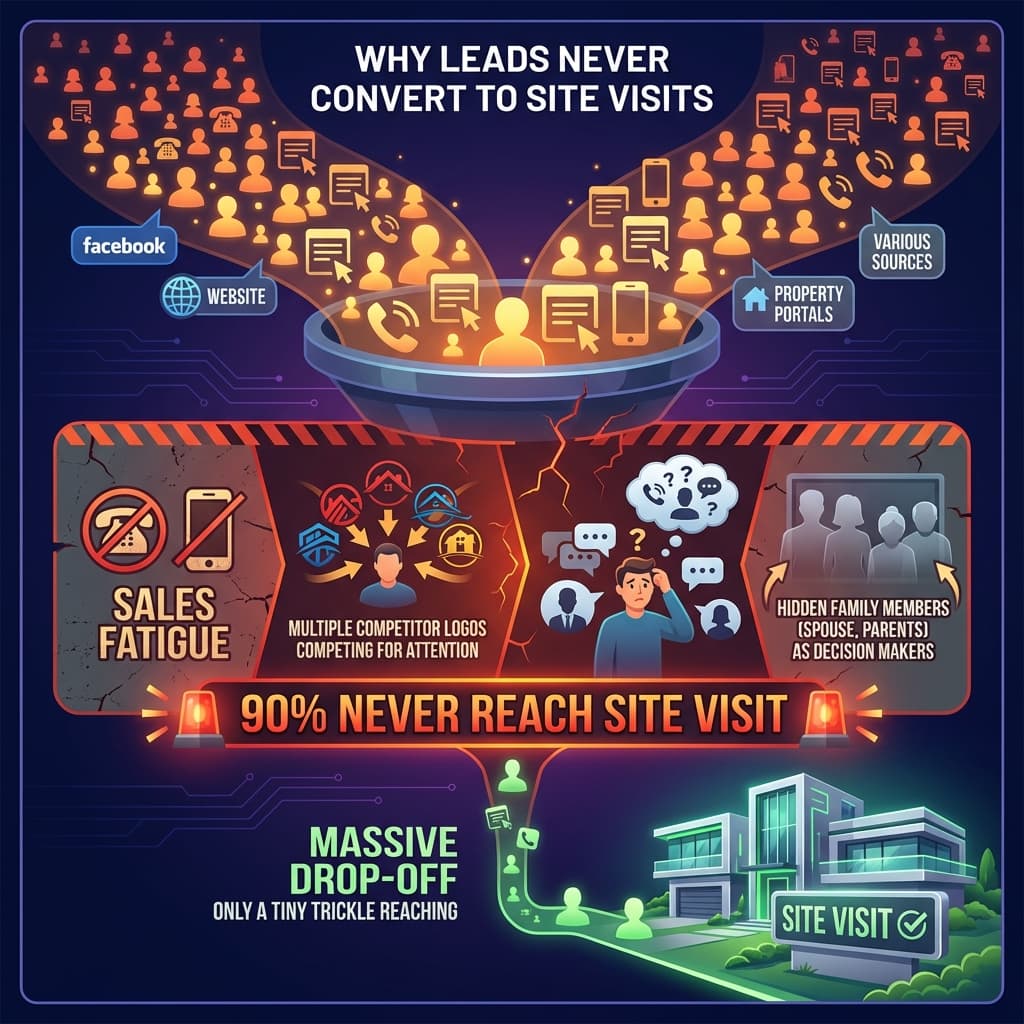
Booking a site visit and having a lead actually show up are two different events. Most sales teams celebrate the booking and ignore the gap. The attended visit is the only one that matters, and closing that gap requires a completely different set of actions than getting the initial yes.
Here is the uncomfortable truth about site-visit bookings: a yes on the phone is not a visit. It is a statement of intent at a moment of low commitment. The lead said yes because saying yes was the easiest way to end the call. They may follow through. They may not. Whether they do depends almost entirely on what happens between the booking and the appointment, and most sales teams do nothing in that window except wait.
Every team that sells high-consideration products, whether that is a flat in Pune, a commercial unit in Hyderabad, or a franchise investment, has a no-show problem they undercount. The CRM shows the booking. It does not automatically flag the no-show or calculate the attended-visit rate as a separate metric. So the booking number looks like progress, the attended-visit number stays invisible, and the team celebrates effort that has not yet produced an outcome.
What is the Confirmation Decay effect, and why does it explain most no-shows?
Confirmation Decay is what happens to a visit commitment after the booking call ends. In the hours and days following a booking, the urgency that made a lead say yes starts to fade. Family priorities surface. Competing options appear. Cold feet set in. The lead does not actively cancel. They just quietly stop planning to show up.
Confirmation Decay is not a personality flaw in your leads. It is a structural feature of how purchase decisions work for high-involvement products. The commitment threshold required to say yes to a booking is much lower than the threshold required to actually leave the house, make arrangements, and spend two or three hours at a site. That gap between the two thresholds is where most visits die, and it is almost entirely addressable with the right sequence of actions in the right order.
The contrarian claim here is this: a booked visit with no follow-through on confirmation is worth roughly the same as no booking at all. The lead has moved no closer to a decision. Your pipeline number has moved, but your actual conversion has not. Teams that optimize for bookings without optimizing for attendance are building a misleading funnel metric that makes every quarter look more productive than it is.
Why does the gap between booking and attendance keep widening?
Several forces work against attendance after a booking is made. First, real estate purchases involve multiple decision-makers. The person who books the visit may be the primary lead, but the spouse, parent, or financial advisor who was not on the call has not said yes to anything. If that person is not aligned before the visit date, the visit gets cancelled because one person does not feel ready.
Second, the time between booking and visit is usually long enough for competing information to arrive. A friend mentions another project. A portal sends a new listing. A broker calls with an alternative. None of these things would necessarily kill the visit, but each one introduces doubt that the original booking call did not pre-empt, because the rep was focused on getting the yes, not on armoring the yes against what comes next.
Third, the friction of actually attending a site visit is higher than most sales teams account for. For a project outside the city or in an area the lead has never visited, coordinating transport, timing, and companions is a real logistical task. If that task feels effortful at the moment it needs to be done, it is very easy to postpone. Postponed visits rarely get rescheduled at the same quality of intent.
What should happen in the window between booking and visit?
Most teams send one reminder, usually a generic WhatsApp message the morning of the visit. That is the minimum viable effort and it produces minimum viable attendance. The window between booking and visit is actually a sequence with three distinct jobs: reinforcing the decision, reducing friction, and re-engaging if the lead goes quiet.
- Within 30 minutes of booking: send a personalised confirmation message with visit details, what to bring, and what to expect. This makes the visit feel real rather than tentative.
- Within 24 hours: share a short piece of content tailored to what the lead asked about on the booking call. If they asked about possession timeline, send a construction update. If they asked about payment plan, send a breakdown. This reinforces that their specific concern is being addressed.
- For visits more than 48 hours away: send something that involves the secondary decision-maker. A floor plan, a video walkthrough, or a project overview they can share with a spouse or parent. A visit cancelled because a family member was not bought in is recoverable before it happens and almost impossible to recover after.
- Day before: a conversational reminder from the rep, not a broadcast template. A short voice note or a WhatsApp message that references something specific from the booking conversation shows that the rep treated this booking as a real relationship, not a number.
- Morning of visit: logistics confirmation. Travel time, who to ask for, parking. Reducing the effort of showing up is a direct lever on attendance rate.
This is not five tasks for a rep to manage manually across hundreds of leads. It is a sequence that should be triggered automatically at booking and executed through your WhatsApp automation layer, with the rep stepping in only for the personalised touchpoints. The automation handles the structure. The rep handles the moments where personal context matters.
What does a no-show actually tell you, and how do you recover it?
A no-show is not the same as a dead lead. In many cases it is the opposite. A lead who booked a visit and did not attend is more interested than one who never booked. They reached a level of commitment that most leads in your funnel never reach. The question is not whether to pursue them but how quickly and with what framing.
The worst recovery approach is a call that opens with any version of "you missed your visit." That framing puts the lead on the defensive and requires them to explain themselves, which is uncomfortable and produces excuses rather than re-engagement. The better framing treats the no-show as a scheduling gap, not a failure: "I wanted to see if we could find a time that works better for you this week." That is a low-friction re-opener that leaves the lead's self-image intact.
No-show recovery also benefits from understanding why the lead did not come. Not all no-shows have the same root cause. Leads who went silent because the secondary decision-maker was not aligned need a different recovery than leads who simply forgot or had a schedule conflict. A voice AI agent can handle the initial outreach and triage: call the no-show, offer to reschedule, and in the conversation gather enough context to tell a human rep whether this is a low-friction reschedule or a lead that needs a different angle entirely.
Rule The attended visit is the first real commitment
A booking is an intention. An attended visit is a decision in progress. Every piece of your post-booking process should be designed to close the distance between those two things, not to celebrate the booking as if the visit already happened.
How does conversation intelligence reveal where your booking-to-visit process is breaking?
When a team looks at its no-show rate and tries to understand it, the usual diagnosis is "leads were not serious." That diagnosis is almost always incomplete and frequently wrong. Conversation intelligence, which is the systematic review of what was actually said during booking calls, usually tells a different story.
Common patterns that emerge from booking call analysis: the rep closed the booking without confirming who else would be involved in the decision. The lead said yes but also mentioned a concern that was not addressed. The rep confirmed a date that the lead chose with visible hesitation. The rep did not give the lead a compelling reason to show up for this specific visit rather than a future one. These are recoverable moments if you can identify them. They are invisible if the only record of the booking call is a field in your CRM that says "visit booked, 14th."
Conversation intelligence tools that transcribe and analyse booking calls let managers identify which patterns precede no-shows. Once those patterns are visible, the team can coach reps to address the secondary decision-maker during the booking call, to surface and resolve hesitation before confirming the date, and to give leads a specific reason to attend rather than a generic appointment. That coaching work compounds. A rep who books visits with 70 percent attendance is doing something different in the booking call than a rep with 40 percent attendance, and conversation analysis makes that difference teachable.
Why do high-volume real estate teams systematically underestimate their no-show rate?
The arithmetic of pipeline reporting hides the no-show problem. Teams track booked visits as a conversion metric. When a no-show happens, it often gets re-categorised as "rescheduled" or left open in the pipeline without a clear lost disposition. The booking number stays healthy. The attended-visit number is either not tracked separately or buried in a report nobody reviews weekly.
The result is a management team that is optimising a number that does not directly connect to revenue. Bookings do not close deals. Attended visits do. If the attended-visit rate is 50 percent of bookings, then every improvement in the booking number produces half the expected improvement in downstream conversion. The team works harder, generates more bookings, and wonders why revenue does not scale proportionally. The gap is the attendance rate, and it was never being measured.
The fix starts with measurement. Track booked visits and attended visits as separate metrics in your CRM or sales dashboard. Calculate the attendance rate by rep, by source, and by project. You will almost certainly find that the rate varies significantly across those dimensions, which means there are specific breakpoints in your funnel that can be improved. A rep with a 35 percent attendance rate is doing something differently from one with a 65 percent rate, and source-level attendance data will show you whether leads from a specific portal or campaign are systematically lower-quality commitments.
How do WhatsApp automation and voice AI work together on the no-show problem?
WhatsApp automation handles the structured sequence: booking confirmation, pre-visit content, logistics reminder. It runs reliably at scale without rep involvement for the routine touchpoints. Voice AI handles the moments that require a conversation but do not need a human rep: no-show outreach, re-engagement after silence, scheduling confirmation with a lead who has not responded to messages.
The combination matters because the booking-to-visit window has two types of moments. Some moments need a message at the right time with the right content, which is what automation does well. Other moments need a two-way conversation to surface hesitation, answer a question, or re-engage a lead who has drifted. A voice AI agent can handle that two-way moment at a scale and consistency that a human rep team cannot maintain across hundreds of booked leads simultaneously.
The handoff between automation and AI outreach and the human rep should be defined clearly. The human rep owns the booking call, the personal touches inside the confirmation sequence, and the conversion conversation during the actual visit. Automation and voice AI own the structure in between. When those roles are clear, the attended-visit rate tends to rise without adding headcount, because the leads who would have silently drifted away are now being held in the funnel by a process that runs independently of rep capacity.
What does a team look like after it starts measuring attended visits separately?
The first visible change is that the pipeline number becomes more honest. Teams that track booked visits as their primary conversion metric often discover that their attended-visit rate is significantly lower than expected. That is uncomfortable information. It is also the only information that lets you fix the right problem. Teams that face this number tend to stop celebrating bookings and start asking what happened between the booking and the visit.
The second change is in coaching. Managers move from reviewing call volume and booking counts to reviewing attendance rates by rep and by source. That shift surfaces the reps whose booking calls are producing high-attendance commitments and the ones whose bookings are soft agreements that dissolve before the visit. The good practitioners become visible and their approach becomes teachable.
- Attended-visit rate tracked separately from booked-visit rate, by rep and by source.
- A post-booking WhatsApp automation sequence triggered at booking, not manually sent.
- Pre-visit content personalised to the concern the lead raised during the booking call.
- Secondary-decision-maker content shared before the visit date, not after a no-show.
- Voice AI outreach triggered within two hours of a confirmed no-show.
- Conversation intelligence review of booking calls where no-shows exceeded team average.
- Re-engagement sequence for no-shows distinct from the standard nurture cadence.
These are not aspirational changes. They are operational decisions that a team can make in a week. The technology to support them, WhatsApp automation, voice AI outreach, conversation intelligence, and buyer intent tracking, exists and works at the scale that Indian real estate and SMB sales teams operate at. The constraint is rarely capability. It is the decision to measure the right thing and build a process around it.
Are you measuring bookings when you should be measuring attendance?
Brixi helps sales teams close the Confirmation Decay gap with automated post-booking sequences, voice AI no-show recovery, and conversation intelligence on every booking call.
Explore how Brixi closes the attended-visit gapFrequently Asked Questions
Confirmation Decay is the main reason. A lead who says yes to a booking is making a low-stakes commitment at that moment. Between the booking and the visit, urgency fades, family members who were not on the call raise concerns, competing options appear, and the logistics of attending start to feel effortful. Without a structured confirmation sequence in the window between booking and visit, most of that decay goes unaddressed. The lead does not actively cancel. They simply stop planning to show up.
Attendance rates vary by project type, ticket size, and lead source, but teams with a structured post-booking confirmation process tend to see attended-visit rates meaningfully higher than those relying on a single WhatsApp reminder. The more important benchmark is your own rate over time. If you are not tracking booked visits and attended visits as separate metrics, you cannot see where the gap is or whether it is improving. Calculating your attendance rate by rep and by lead source is the starting point for any improvement effort.
Contact the lead within two hours of the missed visit, before the psychological window closes. Avoid framing that implies the lead failed to show up. Instead, treat it as a scheduling issue and offer to find a time that works better. If the lead can be reached by phone, a brief two-way conversation to understand what got in the way produces much better reschedule rates than a message. Voice AI agents can handle this outreach at scale across all no-shows simultaneously, with the human rep taking over if the conversation reveals that the lead needs a different approach.
WhatsApp automation improves attendance by running the confirmation sequence consistently across all booked leads, something human reps cannot do reliably at volume. A structured sequence that includes an immediate confirmation message, personalised pre-visit content, secondary-decision-maker materials, and a same-day logistics reminder addresses the main reasons leads do not show up. The automation does not replace the rep for personalised moments, but it ensures the structural support happens every time, not only when a rep remembers to send a message.