Why Real Estate Meetings Keep Getting Cancelled
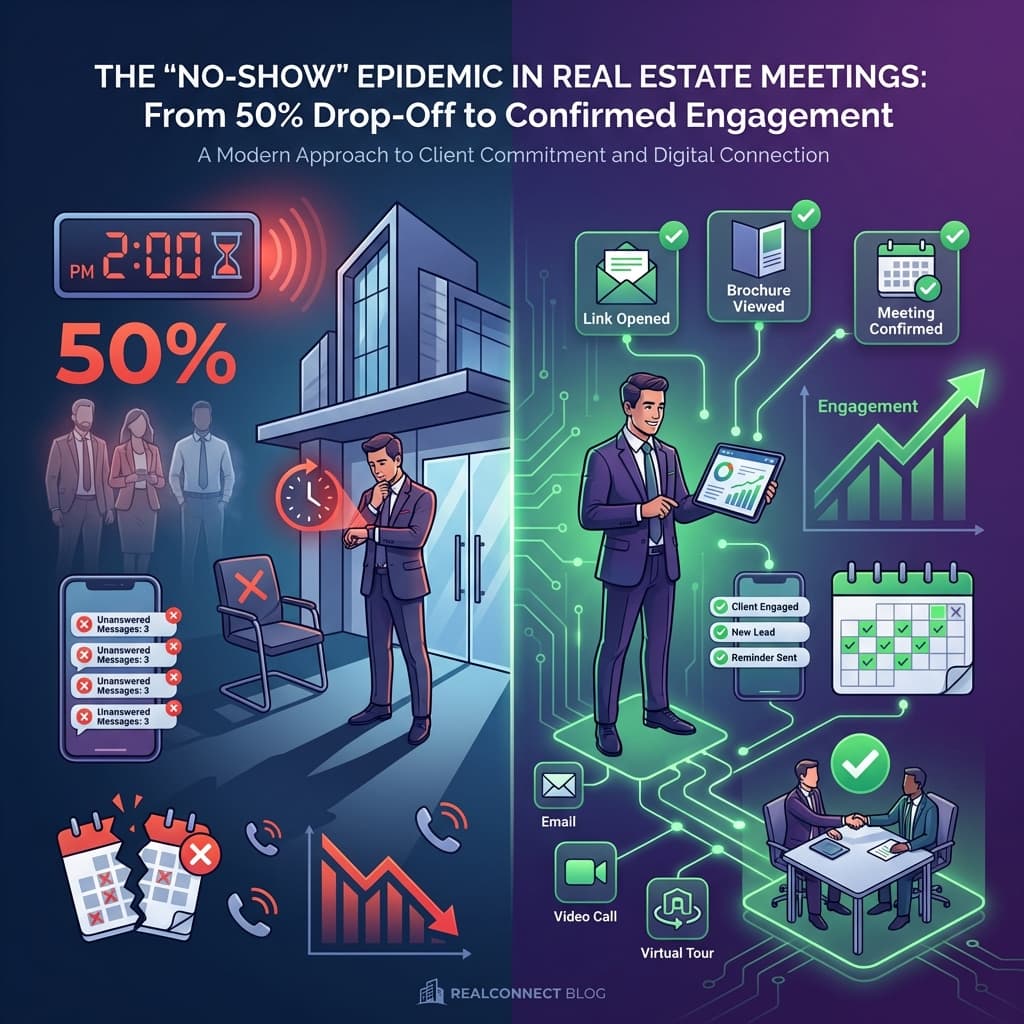
Most site-visit cancellations happen in the 48 hours after booking, not at the last minute. The cause is almost never a change of heart. It is a confirmation process that leaves buyers with unresolved questions and nowhere to take them.
Tarun manages a sales floor for a residential developer in Visakhapatnam. Last quarter, his team had 140 confirmed site visits on the calendar. Ninety-two buyers showed up. Forty-eight did not. Each no-show cost roughly three hours of rep time counting travel, preparation, and the reschedule attempt. Tarun ran the numbers and found the pattern: almost every cancellation message arrived between 6 and 8 PM the night before the visit, and almost every one said the same thing: "something came up." He knew that was not the real reason.
The real reason was that between the moment of booking and the evening before the meeting, the buyer had a question that never got answered. They went looking for the answer on their own, found something that worried them, and cancelled rather than walk into an awkward conversation.
What is the Confirmation Gap?
The Confirmation Gap is the period between when a buyer books a site visit and when they actually show up. During this window, buyers are still deciding. They revisit financing options, look up the project on forums, check possession timelines, and ask their spouse. If your team is silent during this window, the buyer fills the silence with their own research, and that research is uncontrolled.
Most sales teams treat booking as the finish line. A calendar invite goes out, a reminder fires the morning of the meeting, and the rep prepares for the visit. Nobody looks at what the buyer is doing in between. Nobody sees that the buyer opened the pricing PDF at 11 PM, spent 20 minutes on the payment-plan section, and then went to a competitor site at midnight. That pattern is the Confirmation Gap showing its teeth.
Why does the Confirmation Gap open up?
Buyers in real estate are making the largest financial decision of their lives. The booking call feels good in the moment. Then they go home, and the weight of the decision settles. Questions surface that they did not think to ask on the call: what is the maintenance charge, what happens if I need to exit in year two, is the developer RERA-compliant. These are not deal-breaking questions, but if they go unanswered for 48 hours, they become deal-breaking anxiety.
At the same time, most confirmation messages are logistical, not consultative. "Your visit is confirmed for Saturday at 11 AM, here is the address" does nothing to reduce that anxiety. It does not invite the buyer to ask questions. It does not signal that the rep has thought about the buyer since the last call. It is a calendar event, not a relationship touch.
What does a Confirmation Gap look like in practice?
Consider a buyer who books a visit to a project in the western suburbs of Mumbai. On the booking call, they express interest in a 2BHK and ask about the floor plan. The rep sends a PDF and logs the meeting. Two days pass. The rep sends the standard reminder the morning of the visit.
What the rep does not know: the buyer opened the PDF the night after booking, spent time on the pricing page, and then searched for reviews of the developer. They found a thread on a housing forum with some negative comments about delayed possession on a previous project. They shared that link with their spouse. By the morning of the visit, both of them had talked themselves into skipping it. The cancellation message went out at 7 AM.
If the rep had known the buyer returned to pricing and was reading forums, a short message two days earlier could have addressed the possession concern directly. "I saw you were reviewing the project details. Happy to walk you through the possession schedule and our completion track record before Saturday if that helps." That message closes the Confirmation Gap before the buyer opens a competitor tab.
How do most teams try to fix no-shows, and why does it not work?
The standard fix is volume: more reminders, more calls, an automated SMS the day before and a WhatsApp the morning of. Teams figure that if they stay visible, cancellations will drop. In practice, sending more reminders into a silent Confirmation Gap does not help. It can make things worse. A buyer who is already anxious about an unanswered question does not want another calendar nudge. They want someone to address the question.
- Generic reminders confirm logistics but do not reduce decision anxiety.
- High-frequency nudges signal process, not relationship, which lowers trust.
- No-show follow-up scripts focus on rescheduling, not on diagnosing why the buyer dropped.
- Treating the cancellation as a lead-quality problem hides the process failure.
- Splitting confirmation responsibility between sales and ops means nobody owns the gap.
Rule Reminders vs resolution
A reminder tells a buyer when to show up. Closing the Confirmation Gap tells a buyer why they should. The first is logistical. The second is sales.
What signals predict a cancellation before it happens?
Buyers who are about to cancel do not go silent. They go looking for answers in the wrong places. The signals appear in their digital behavior during the Confirmation Gap window. Teams that can read these signals can intervene before the cancellation message goes out.
- Return visits to pricing or payment-plan content two or more days after booking.
- Time spent on possession, legal, or RERA-related sections that were not viewed before.
- Sharing the project microsite or document link with a second device or family member.
- Visiting a competitor project page within the same session as your microsite.
- No engagement with any project content for more than 36 hours after booking.
- Opening the meeting confirmation and not clicking the location link.
None of these signals individually means the buyer will cancel. Taken together, especially pricing review plus external research plus extended silence, they are a reliable early warning. Teams that monitor them can re-engage with context rather than with generic reminders.
What changes after a quarter of closing the Confirmation Gap?
Teams that actively manage the Confirmation Gap report a different kind of sales floor within three months. Reps spend less time on reschedule calls and more time on preparation. The conversations at site visits are more substantive because buyers arrive having already addressed their basic concerns. Reps walk in knowing which sections the buyer spent time on, which means they can lead with the most relevant part of the visit.
Pipeline data also becomes more reliable. A confirmed meeting that has had active buyer engagement in the gap is a real indicator of intent. A confirmed meeting with no engagement is a watch item. Managers can see this before Monday morning and adjust the week accordingly rather than discovering it when the rep calls from an empty site office.
The downstream effect on conversion also improves. Buyers who have had their pre-visit questions answered arrive in a closing mindset, not an evaluating one. That shift shortens the in-person conversation and raises the likelihood of a same-day progression. In deployments we see with Brixi customers, the show-up rate improvement often compounds into a conversion improvement, because the same gap-closing process filters for buyers who are genuinely ready.
Tarun ran the same quarter again with gap-closing in place
Tarun built a simple rule into his team's process. Any buyer who revisited pricing or external content during the Confirmation Gap got a non-logistical message within four hours: one line that acknowledged the section they were reading and offered to address it before the visit. No pressure. No reschedule ask. Just resolution.
His team needed intent signals to make that rule work. They needed to know when a buyer was back in the project material. Once they had that visibility, the intervention took 90 seconds per buyer. The next quarter, the show-up rate improved substantially, and the cancellations that did happen were from buyers who had clearly moved on, not from buyers who had been lost to silence.
The broader bet here is simple. Every real estate project invests heavily in marketing to get a buyer to the booking call. The Confirmation Gap is where that investment either compounds or leaks. Closing it is not a technology problem. It is a signal-reading problem. Teams that can see what buyers do between booking and meeting day have a structural advantage that no amount of reminder automation can replicate.
How many of your confirmed meetings are at risk right now?
Brixi tracks buyer activity during the Confirmation Gap and surfaces intervention prompts before cancellations happen, so your reps engage at the right moment with the right context.
Explore the buyer-intent engineFrequently Asked Questions
Most cancellations arrive in the 6 to 20 hour window before the scheduled meeting. But the decision to cancel typically forms 24 to 48 hours earlier, during what we call the Confirmation Gap, when buyers revisit their questions and find no one available to answer them. Intervening during the gap, not the morning of the visit, is what changes the outcome.
A useful confirmation message goes beyond logistics. It acknowledges something specific about what the buyer is evaluating, for example the floor they shortlisted or the payment plan they asked about, and it opens a door for questions before the visit. Generic messages confirm calendar events. Contextual messages confirm the relationship and lower pre-visit anxiety.
The signals are behavioral. Buyers who return to pricing content, visit competitor pages, or go completely silent after booking are showing early cancellation risk. Buyers who share the project link with a family member and revisit possession details are showing high intent but unresolved concerns. Both groups need outreach, but the message is different for each. Intent tracking makes this legible before the cancellation message arrives.
Not reliably. Reminder volume addresses a logistics problem, which is not the main driver of cancellations. Most buyers who cancel did not forget the meeting. They lost confidence during the Confirmation Gap. Adding a third reminder into that silence does not resolve the underlying question. A single contextual message that acknowledges what the buyer has been reading and offers to address it does far more than three generic nudges.