Why AI Agents Fail Without a Shared Context Layer
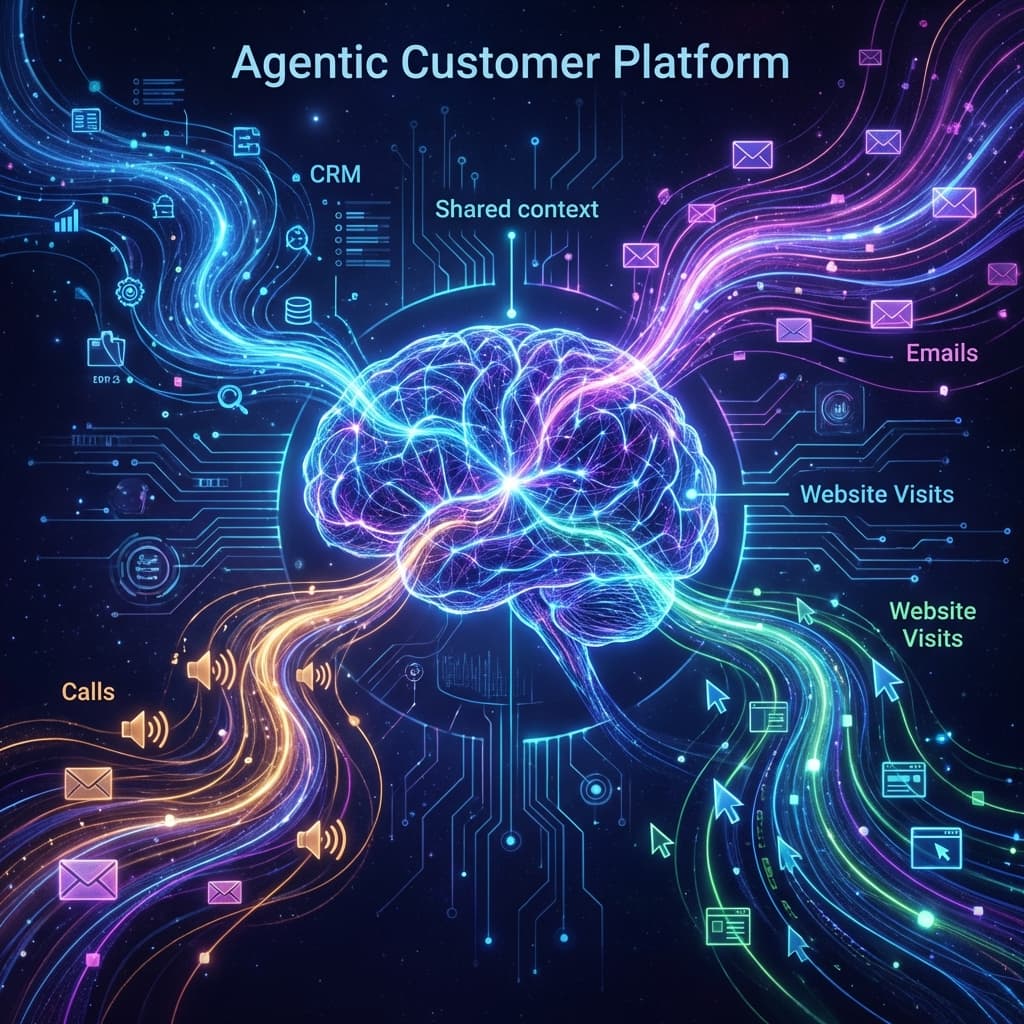
Most sales AI deployments break not because the models are weak but because every agent operates on its own slice of data. When context is fragmented, timing collapses. This post explains the Context Debt problem and how a unified agentic platform fixes it.
Prabhleen manages the sales operations desk for a mid-size residential developer in Hyderabad. In March she ran a post-mortem on seventeen deals that stalled in week two of follow-up. Every one of those leads had a CRM entry, a WhatsApp thread, a microsite link, and at least one scheduled callback. The AI calling agent had made contact. The AI chat agent had answered questions. The AI email agent had sent the project brochure. Yet when her team reviewed the transcripts, each agent had introduced itself without any awareness of what the others had already said.
The buyers had not gone cold. They had grown tired of being treated as strangers by a system that was supposed to know them. That is Context Debt: the compounding cost of running intelligent agents on disconnected data.
What is Context Debt?
Context Debt accumulates whenever a new agent interaction begins without the history of prior interactions. Each isolated touchpoint forces the buyer to re-establish who they are, what they have already seen, and where they are in their decision. In a single-agent world this is a minor annoyance. In an agentic stack where four or five specialized models touch the same lead, it becomes the primary reason conversion stalls.
The term "agentic" implies autonomy, but autonomy without shared memory produces coordination failures. A calling agent that does not know the buyer spent forty minutes on the payment-plan page yesterday will open with a generic pitch. A follow-up email agent that does not know a site visit was already discussed will suggest scheduling one as if it were a new idea. The buyer notices. The rep does not, because the CRM logs activity counts, not context quality.
Why does Context Debt get worse as you add more AI?
Adding agents without a shared context layer is additive in cost but not in capability. Each new model introduces its own state, its own session window, and its own interpretation of the buyer. The surface area for contradiction grows with every integration. Teams deploying AI for calling, chat, email, and qualification scoring without a unified context graph are not building an agentic platform. They are building a coordination problem.
- A calling agent re-qualifies a buyer the chat agent already qualified two days prior.
- An email sequence references a configuration option the buyer explicitly rejected on a prior call.
- A scoring model marks a lead as cold because the buyer has not replied to email, while microsite data shows three sessions in the last 24 hours.
- A human rep inherits the lead with contradictory notes from two separate agents, each confident in its own partial view.
- The buyer, having experienced the repetition, stops engaging entirely before the human ever calls.
What does a shared context layer actually contain?
A shared context layer is not a master CRM record. It is a live, structured graph of buyer state: what content has been consumed, which objections have been raised, what the buyer said about timeline and budget, which stakeholders have been involved, and what each prior agent did in response. Every agent reads from this graph before acting and writes back to it after every interaction. The result is that the fifth touchpoint feels like a continuation of the first, not a reset.
Brixi calls this layer Pulse. Pulse sits beneath the calling agent, the chat agent, the microsite tracking layer, and the follow-up engine. When the calling agent opens a conversation, it receives a structured brief: buyer name, project interest, last content consumed, last agent interaction, open objections, and a recommended conversation opening. Context Debt drops to near zero at the point of first word.
How does an agentic platform differ from an AI-powered CRM?
An AI-powered CRM adds intelligence on top of a record-keeping system. It can surface summaries, suggest next steps, and score leads. But it still frames the buyer as a static profile being acted on by a human team. An agentic customer platform frames the buyer as an active participant whose behavior drives real-time decisions by autonomous agents. The key difference is agency on both sides: the platform agents adapt without waiting for a human to interpret a dashboard.
Note CRM vs agentic platform
A CRM records what your team did and prompts the next human action. An agentic platform reads live buyer behavior and triggers the next agent action without waiting for a rep to log in.
What changes after a quarter of running on shared context?
Teams that eliminate Context Debt consistently report a shift in where time is spent. Reps stop re-qualifying leads that the system already knows. Managers stop reconciling conflicting agent outputs in morning stand-ups. Coaching sessions move from correcting repetitive mistakes to refining the actual conversation strategy. The operational noise that comes from fragmented AI drops, and the signal from genuine buyer behavior becomes the primary input for daily prioritization.
There is also a compounding effect on the agents themselves. Because every interaction writes back to the shared context graph, the scoring models improve on real outcomes from real conversations rather than synthetic training data. A calling agent that learns which conversation openings work for buyers who have already consumed pricing content will outperform a generic model within weeks, not months.
- Follow-up conversations start from where the last one ended, not from zero.
- Intent scoring reflects live microsite, call, and chat behavior together.
- Reps receive a single pre-call brief instead of reviewing three separate tool dashboards.
- Managers can audit agent decisions by reading the same context the agent used.
- Buyer frustration from repetitive re-qualification drops noticeably.
- Conversion timing improves because the right agent acts at the right moment without a rep having to notice the signal.
How do you identify Context Debt in your current stack?
The clearest diagnostic is a transcript audit. Pull ten leads that stalled after the second week. Read every agent interaction in sequence. Count how many times the buyer was asked something they had already answered, or how many times an agent referenced content the buyer had already consumed and moved past. If that number is higher than one per lead, Context Debt is eroding your pipeline.
A second diagnostic is scoring-vs-behavior divergence. Take leads your scoring model marks as cold. Cross-reference against microsite session data for the same period. If buyers marked cold have recent deep-session activity on pricing or possession content, your scoring model is running on a context island. It is not seeing the buyer. It is only seeing the silence on one channel.
Prabhleen closed the gap: the longer bet
When Prabhleen ran the same post-mortem framework six weeks after connecting all agents to a shared context layer, the pattern changed. Buyers were still silent on some channels. But the context graph showed exactly which channel was active and what the buyer had reviewed most recently. The calling agent opened its next conversation from that context, not from a cold start. Three of the seventeen deal types that had stalled in the previous cycle converted in the new one.
The deeper bet behind an agentic customer platform is not that AI is smarter than a good rep. It is that a system with shared, real-time context can sustain the right conversation across every channel, at any hour, with every lead, without requiring a rep to be present for each step. Context is the operating system. Every agent is just an application running on top of it. When the operating system is missing, the applications fight each other for ownership of a buyer who is simply trying to make a decision.
How much Context Debt is your current AI stack carrying?
Brixi connects your calling, chat, microsite, and scoring agents to a single shared context layer so every touchpoint builds on the last.
Explore the agentic platformFrequently Asked Questions
Context Debt is the compounding cost of running multiple AI agents on disconnected data. Each agent that acts without awareness of prior interactions forces buyers to re-establish context, introduces contradictions across touchpoints, and erodes conversion over time. The post-mortem framework described in this post is the standard way to measure it.
An AI-powered CRM adds intelligence to a record-keeping system and surfaces suggestions for human action. An agentic customer platform connects autonomous agents to a live context graph so they can act without waiting for a rep to interpret a dashboard. The distinction is whether AI is assisting a human decision or making a timing-sensitive decision on its own.
Most scoring models are trained on a single data source, usually email or CRM activity. When a buyer goes quiet on email but is actively reviewing pricing and possession content on a microsite, a single-source model has no visibility into that behavior and scores the lead as cold. A shared context layer solves this by feeding the scoring model behavior from every channel simultaneously.
Most teams notice operational changes within the first two to three weeks: fewer re-qualification calls, cleaner pre-call briefs, and more consistent agent outputs. Conversion impact typically becomes measurable in the four to six week range, once enough leads have moved through a full cycle using the shared context layer. The compounding improvement in agent scoring models takes longer, usually two to three months of live data.