7 Buyer Intent Signals That Tell You a Lead Is Ready to Buy
Most sales teams follow up by schedule, not by signal. The leads who are ready to buy right now are leaving behavioral footprints that most reps never read. Here is how to spot them before a competitor does.
Aditya runs a team of nine sales executives at a mid-size residential developer in Pune. Last quarter he pulled every lead that had gone cold in the 21 days before their project launch. One pattern kept showing up: the buyer had downloaded the pricing brochure, asked a question about the payment plan, then stopped replying. His reps marked them as "no response" and moved them down the priority list. Three weeks later, six of those buyers booked units with a project two kilometres away. The buyers were not gone. They were deep in final evaluation, carrying every buyer intent signal Aditya’s system could not read.
Here is the part that stings: those buyers were more ready to purchase at the moment they went quiet than at any point before. Going silent is not indecision. In high-value sales, silence is almost always due diligence. The buyer is running internal consensus, comparing EMI structures, and aligning move-in timelines with a spouse or parent. They have stopped asking you questions because they have enough information to evaluate without you. If your follow-up system treats "no reply" as "not interested," you are optimising for the wrong signal.
What is the Conviction Cluster and why does it matter?
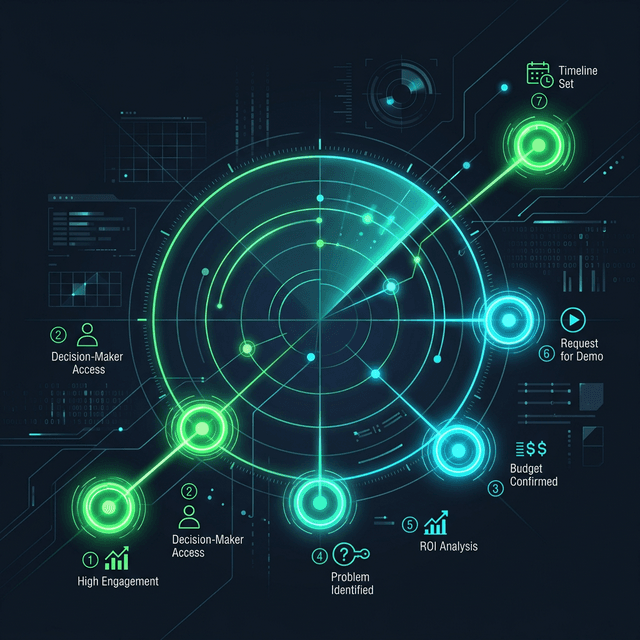
The Conviction Cluster is the specific pattern of behavioral signals that appears when a buyer moves from consideration into final evaluation. It is not a single action, a revisit, or a download in isolation. It is a cluster: multiple high-intent behaviors appearing in a compressed window, usually two to five days. Individual signals mean interest. A Conviction Cluster means readiness. Most sales teams can track individual signals if they try. Very few track the cluster, because doing so requires a unified view of call logs, content engagement, and digital behavior on a single surface. The teams that do track it do not just close faster. They close more, because they are calling the right person at the right moment rather than calling everyone on a rotating schedule.
Which 7 buyer intent signals make up the Conviction Cluster?
These are behavioral purchase intent signals observed across real estate, lending, and high-ticket B2B sales. None of them require a buyer to say anything. All of them are readable if your content lives on a trackable surface.
- Pricing content revisited within 48 hours of a call or share. A buyer who returns to the pricing section after a conversation is running the numbers again, usually for a second decision maker in the household. A first-time view is curiosity. A return view within two days is evaluation.
- Payment plan or EMI section engagement. No one models loan repayments on a property they are not seriously considering. Finance content is the clearest purchase intent signal available and is systematically undertracked by most sales teams.
- Possession or handover date views. Timeline content is almost exclusively consulted by buyers who are aligning their own plans. A browser does not calculate whether the completion date fits their rental contract.
- Floor plan focus narrowed to one unit type. When a buyer stops browsing all configurations and returns repeatedly to a single unit, they are visualising themselves in that space. The browsing phase is over.
- Stakeholder sharing or second-viewer activity. When the same microsite or document opens from a second device or a different location, a second decision maker has entered the picture. This is the strongest single signal in the Conviction Cluster because it means internal advocacy has begun.
- Visit booking page clicks without completion. An abandoned booking attempt tells you the buyer is ready enough to try, but hit friction on the form or availability. This warrants an immediate, low-pressure call and a direct offer to schedule the visit over the phone.
- Return within 24 hours after a quiet period of five or more days. A buyer who went dark and came back is not browsing randomly. Something shifted in their decision context, a salary credit, a family conversation, a competing project that did not work out. They are re-evaluating, and the window is short.
Why does acting on a single signal alone cause more harm than good?
This is the contrarian point most teams miss. Acting on individual signals without looking for the cluster produces noisy, premature follow-up that burns out buyers who are only mid-consideration. If you call every time someone opens a pricing PDF, you will annoy a substantial portion of leads who are still in the early browsing phase. The result is a reputation for being pushy at exactly the moment your prospect is forming their first impression of you.
The Conviction Cluster disciplines your follow-up by requiring multiple high-intent behaviors before routing a lead to priority outreach. A buyer who viewed pricing once and visited the floor plan section once is browsing. A buyer who viewed pricing twice, visited the payment plan section, and opened a second session from a new device in a 72-hour window is in final evaluation. Same lead profile. Very different follow-up urgency.
Why do most CRM follow-up systems miss these behavioral lead scoring signals?
Cadence versus signal
A time-based cadence asks "how long has it been?" A behavioral lead scoring system asks "what has changed?" The second question is the one that finds buyers inside the Conviction Cluster. Most CRMs are built to answer the first question.
The structural problem is tool fragmentation. Calls are logged in one place. Content is shared over WhatsApp. Microsites sit on a separate platform. PDFs are forwarded as attachments with no tracking layer. No single screen shows all three simultaneously. A lead who opened your microsite pricing section four times in 48 hours looks identical to a lead who has not touched your content since day one, because both show "no reply" in the CRM.
The second problem is that most lead scoring systems in mid-market CRMs assign points to demographic data, not behavioral data. A lead from a premium locality gets a higher score than a lead from a tier-two area, regardless of what either of them has actually done with your content. This demographic bias consistently underscores high-intent buyers from outside your assumed profile and overscores low-engagement leads who match your ideal customer description on paper.
How do you read these signals without a dedicated intent platform?
Start with a single trackable surface. When all your content, pricing PDFs, floor plans, possession timelines, and booking links live inside one personalized microsite rather than scattered across WhatsApp forwards and email attachments, you get clean section-level events without complex instrumentation. A buyer who opens a shared PDF tells you nothing about which section they read or how long they spent on it. A buyer who opens the same content inside a tracked microsite gives you a full behavioral map.
Once the surface is in place, define your Conviction Cluster threshold before going live. In most residential real estate deployments, three or more high-intent events from the list above, appearing within a 72-hour window, reliably separates buyers in final evaluation from those still browsing. Set that as your alert threshold, route those leads to your highest-performing rep, and hold the follow-up to within 90 minutes of the alert. The timing matters as much as the content of your call.
What changes after a quarter of signal-based follow-up?
The most immediate change is follow-up timing. Instead of calling on day three because the cadence says so, you call within an hour of a pricing revisit because the signal says the buyer is in evaluation mode right now. That call lands differently: the buyer is already thinking about the property, and you arrive with context rather than a cold reminder.
The second change is follow-up content. When you know a buyer has spent time on the payment plan section but has not looked at the possession timeline, you know exactly what friction to address. You open with "I wanted to walk you through the construction-linked plan that most buyers in your bracket find easier to plan around," not a generic check-in. The rep sounds informed rather than persistent.
The third change is pipeline visibility. Teams using the Conviction Cluster as a routing trigger typically find that their pipeline did not grow because more leads came in. It grew because fewer ready buyers slipped through without being contacted at the right moment. The volume stays the same. The conversion rate at the bottom of the funnel improves because the buyers who were quietly deciding now get a well-timed call instead of a belated one.
There is a downstream effect on morale as well. Reps who call cold on a rotating schedule experience a high rate of disinterest and rejection, which degrades their confidence and their pitch quality over time. Reps who call on signal have a much higher rate of engaged conversations, because the person on the other end of the call is already thinking about what the rep is calling about. In deployments we track, this shift in conversation quality is often cited by reps as more motivating than any change in commission structure.
Which anti-patterns should teams actively avoid?
- Disclosing the signal as the reason for calling. "I saw you were on our pricing page" creates discomfort. Use the signal to inform what you say, not as the stated reason you are calling.
- Setting the cluster threshold too low. If two minor events trigger a priority alert, reps get flooded with noise, stop trusting the system, and revert to manual judgment. Start conservative and calibrate.
- Ignoring the cluster when it appears at inconvenient times. A Conviction Cluster that fires at 7 PM on a Friday still deserves a follow-up. A WhatsApp message sent within the hour, even if not answered, marks the moment and gives you a warm opener the next morning.
- Using intent signals only on new leads. Some of the most valuable Conviction Clusters appear on leads that were marked cold three or four weeks earlier. A buyer who went quiet and came back is often further along in their decision than a brand-new lead.
- Skipping the cluster analysis review. Teams that do not hold a weekly session mapping signal clusters to conversions miss the feedback loop that tells them which threshold settings are working and which need adjustment.
What is the deeper bet on signal-based follow-up?
Six months after Aditya moved his team onto tracked microsites and defined a Conviction Cluster threshold of three events in 72 hours, a lead that had been cold for 11 days came back and revisited the possession timeline and the payment plan section within a single session. His rep received an alert, called within 45 minutes, and opened with a comment on the construction-linked plan. The buyer said they had been sorting out a home loan pre-approval and were ready to visit that weekend. The deal closed four days later.
The six buyers Aditya lost before that change were not lost because of poor products or bad pricing. They were lost because his team had no way to see that those buyers were inside the Conviction Cluster at the moment they went quiet. They assumed silence meant stall. The buyers assumed no follow-up meant the team was not particularly interested.
The deeper bet on behavioral lead scoring is not really about software. It is about a fundamental reframe of what "ready to buy" looks like. Ready buyers do not raise their hands. They get quieter, more deliberate, and more focused on the details that matter for a final decision. Your job is not to be the loudest voice during that period. Your job is to be the most well-timed one. Signal-based follow-up is the operational mechanism that makes that possible at the scale of a full sales team.
Are your ready buyers sending signals your team cannot see?
Brixi tracks buyer behavior across your microsites and content, surfaces the Conviction Cluster in real time, and routes priority leads to your best rep before the window closes.
Explore the Brixi intent engineFrequently Asked Questions
Start with a single trackable surface such as a personalized microsite. When all your content, pricing, floor plans, and booking links live in one place, you get clean section-level events without complex instrumentation. Even basic link-tracking on shared documents will show you revisit behavior, which is the first signal to act on. The key is consolidating content distribution onto one surface so behavioral data is not scattered across WhatsApp, email, and untracked PDFs.
Stakeholder sharing, specifically when a second device or second viewer opens the same content, is the strongest individual signal in most deployments. It means internal advocacy has begun. The buyer you have been speaking with is now presenting your offering to someone else on your behalf. That handoff moment is the best time to offer a joint walkthrough or family site visit, because the second decision maker is actively engaged.
It varies by price point. For residential real estate in the 50 lakh to 1.5 crore range, most high-intent evaluation windows last 3 to 10 days. Above that range, it can extend to 2 to 3 weeks. The key is not to time the average but to respond to the cluster when it appears, because the gap between active evaluation and a competitor booking is often shorter than teams expect. Missing the window by even two days can mean losing the deal entirely.
No. Use the signal as context for your outreach, not as its stated reason. Instead of "I saw you on the pricing page," say "I wanted to walk you through the payment structure because a lot of buyers at this stage find the construction-linked option easier to plan around." The signal tells you when to call and what to address. It does not need to be disclosed, and disclosing it usually creates more discomfort than it resolves.