Personalized Microsites That Surface Real Buyer Intent
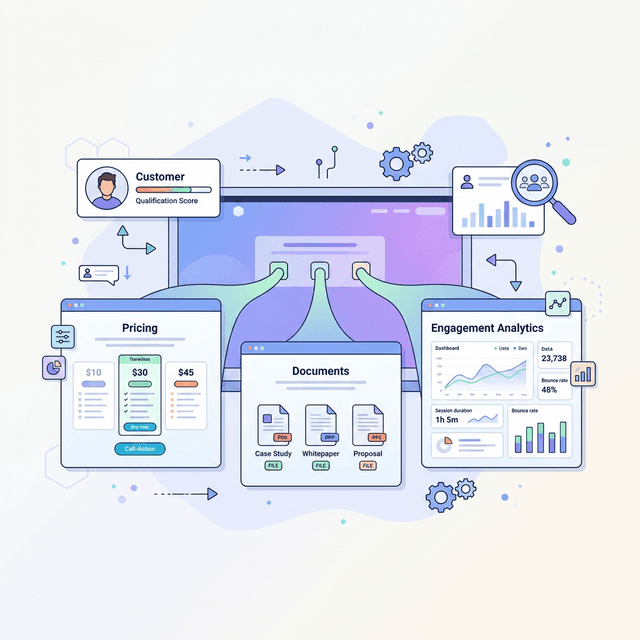
Most sales teams qualify leads on profile fit and response speed. Neither tells you who is actually ready to buy. Personalized microsites fix this by turning every buyer interaction into observable, rankable evidence of intent.
Lavanya Krishnan manages a ten-person sales team at a Pune-based proptech firm. In January 2026, her team was running a full pipeline: eighty active leads, daily follow-ups, a busy CRM. Conversion was stuck at four percent. When she audited why, the answer was not effort. It was sequencing. Her reps were spending the same time on a lead who had glanced at a brochure PDF as on a buyer who had mentally shortlisted the project. They could not tell the difference because the brochure told them nothing.
Lavanya replaced the brochures with personalized microsites, one per serious prospect, each containing pricing, floor plans, payment terms, and a comparison section. Within six weeks she had a new problem: too much signal. She needed a framework to read it. This post is that framework.
Why profile fit is not the same as purchase intent
Most Indian sales teams qualify on two dimensions: demographic fit and response speed. The lead is the right income bracket, the right city, the right job title. They replied within an hour. Both facts are comforting but neither tells you where the buyer is in their actual decision. Someone can match your ideal profile perfectly and still be eight months away from signing. Someone can be slow to respond and still return to your pricing page four times in a day.
This is the core problem that buyer intent tracking is designed to solve. Intent is not who the buyer is. It is what the buyer is doing with the information you have shared. Personalized microsites make that behavior visible in a way that scattered PDFs, WhatsApp attachments, and email threads never can.
What exactly is a personalized microsite in a sales context
A personalized microsite is a dedicated, trackable web page built for a single prospect or account. It consolidates every piece of content relevant to that buyer: pricing, product demos, case studies, testimonials, payment options, legal terms. The buyer gets one link instead of a folder full of attachments.
For the sales team, the microsite is an intent radar. Every section view, every revisit, every scroll depth, every instance of the link being forwarded to a colleague is a data point. When you know a buyer spent eleven minutes on the payment schedule section two hours before your follow-up call, you are not guessing at conversation context. You have it.
In real estate sales, this matters enormously. A buyer researching a 1.2 crore apartment is not going to commit in one call. The decision involves a spouse, possibly parents, a financial advisor. Personalized microsites let a rep see exactly which family member revisited the EMI calculator section and when, giving the rep a precise signal about where internal deliberation stands.
The Behavioral Depth Score: the concept that changes qualification
Here is the ownable concept this post introduces: the Behavioral Depth Score. It is a simple mental model, not necessarily a formal CRM field, though you can make it one. The Behavioral Depth Score asks: how deep into decision-critical content has this buyer gone, and how recently.
Depth here means the nature of the content viewed, not just the volume. Overview pages are shallow. Pricing, legal, implementation, and comparison pages are deep. A buyer who has spent time on deep content has mentally moved past exploration. They are evaluating. That is a different conversation to have, and it should be ranked higher than a buyer who replied to three messages but never opened the microsite.
Recency matters as much as depth. A buyer who reviewed your payment terms nine days ago and has been quiet since may be cooling. A buyer who reviewed the same section yesterday afternoon and then forwarded the link internally is accelerating. The Behavioral Depth Score captures both dimensions: how far in and how recently.
What lead behavior tracking actually looks like in practice
Lead behavior tracking is not a technology category. It is a discipline. The technology, whether it is a CRM, a sales engagement platform, or Brixi's buyer intent engine, only surfaces the data. The discipline is deciding what that data means and what to do next.
A practical lead behavior tracking setup for a B2B or real estate team in India looks like this. Every microsite has section-level analytics. The rep receives a notification when a buyer revisits. The CRM log captures the depth and recency of each session automatically. Before every follow-up call, the rep reviews the last three sessions: what was viewed, in what order, for how long. That review takes two minutes and produces a contextual opening for the conversation.
- Buyer revisits pricing or payment section within 24 hours of a call: high Behavioral Depth Score, escalate to senior rep.
- Buyer views overview twice but never opens pricing: early-stage, keep nurture cadence educational.
- Buyer forwards microsite link to a new email address: committee has expanded, prepare multi-stakeholder pitch.
- Buyer reads legal or compliance section in detail: procurement or legal is now involved, adjust conversation accordingly.
- Buyer returns to a comparison section after a competitor call: re-evaluation is active, timing is critical.
- No microsite activity for seven or more days after previous engagement: lead may be stalling, check with a direct question.
The anti-patterns that kill qualification accuracy
Most teams that adopt personalized microsites make one of three errors. Understanding them in advance saves weeks of wasted cycles.
The first anti-pattern is the Completeness Trap. A rep builds a microsite so thorough that every lead receives an identical, exhaustive page. The microsite becomes a digital brochure, not a personalized artifact. There is no differentiation by stage or by what you already know about the buyer. The solution is to keep microsites lean and stage-appropriate. A lead who just entered the pipeline should not receive the same page as a buyer who has asked for a payment plan.
The second anti-pattern is Signal Overload. Teams collect every available data point but have no agreed definition of what constitutes a high-intent signal. Reps spend time debating whether a twenty-second session means anything. The solution is to pre-define your signal thresholds before you launch your first microsite. Three minutes on a pricing section is high intent. Ten seconds is noise. Write it down.
The third anti-pattern is the Orphan Follow-Up: a rep calls a buyer without reviewing the most recent microsite session. The rep opens with a generic line. The buyer has already mentally moved to the payment structure conversation. The call feels out of sync. The buyer loses confidence. The solution is a non-negotiable two-minute microsite review before every call.
The contrarian truth about activity volume
A rep who sends eight follow-up messages to a low-intent lead is not working hard. They are working in the wrong direction. Personalized microsites reveal which leads deserve intensity and which ones need patience. Effort spent on the right leads produces more closes than effort spread across all leads equally.
How sales engagement analytics connects behavior to coaching
Sales engagement analytics is where the team-level picture comes together. Individual reps see their own microsite data. Managers see patterns across the whole pipeline. Which types of content correlate with deals that close. Which follow-up timing, based on when a buyer last visited a deep section, produces the best conversion rates. Which rep is consistently ignoring behavioral signals and defaulting to generic cadences.
For an edtech or lending team, this is particularly powerful. An edtech counsellor dealing with a hundred enquiries a week cannot rely on memory to track who reviewed the course fee structure and who did not. Sales engagement analytics makes that visible at a team level, so managers can coach on specific moments: "This buyer reviewed the EMI section three times. Why did your follow-up message not reference financing options."
The output of strong sales engagement analytics is not a report. It is a set of calibrated response playbooks: if a buyer does X, a rep does Y within Z hours. Those playbooks get sharper each week as the team reviews what worked.
Building a microsite that generates readable intent signals
A microsite that surfaces useful buyer intent signals is structured around buyer questions, not around what your company wants to say. The sections should mirror the stages of a buyer's decision: understanding the product, understanding the cost, understanding the risk, understanding the transition. Each section is a question the buyer is trying to answer.
- Section 1: What does this product actually do for my specific situation. Keep this brief and concrete.
- Section 2: What will it cost, including implementation or onboarding. Be specific. Vague pricing generates anxiety, not intent.
- Section 3: What do buyers like me say after six months. Case studies with named outcomes, not testimonial blurbs.
- Section 4: What does the transition look like. Timeline, support, what breaks during migration.
- Section 5: What are the terms. Legal, SLA, exit clauses. Buyers who reach this section have mentally committed to evaluating seriously.
Each section you add should answer a real objection or a real question your sales team hears in calls. If a section does not map to a buyer question, remove it. Shorter, intent-mapped microsites produce cleaner behavioral signals than long ones that buyers skim.
What changes after a quarter of running personalized microsites
Teams that run personalized microsites consistently for ninety days report a pattern of changes that are less about the technology and more about how the team thinks.
The first change is that pipeline reviews stop being status updates. Instead of a rep saying "this deal is warm, I spoke to them last week," the conversation becomes "the buyer reviewed the pricing section twice on Tuesday and forwarded the link. Here is what I am doing next." The conversation has evidence. Managers can challenge or endorse specific next steps.
The second change is that reps develop sharper intuition about buyer stages. Because they are reading behavioral signals daily, they begin to recognize patterns faster. A buyer who hits the comparison section early usually has an incumbent vendor in mind and needs a differentiation conversation. A buyer who returns to the case study section before signing needs one more proof point. These patterns become part of the team's institutional knowledge.
The third change is forecasting accuracy. When pipeline stages are backed by behavioral evidence rather than rep optimism, forecasts become more reliable. A deal in "proposal stage" means the buyer has reviewed the proposal microsite in depth within the last seventy-two hours. A deal in "proposal stage" where the microsite has not been opened in two weeks is a different situation entirely.
Teams in healthcare sales and lending see an additional benefit: compliance. When a buyer has reviewed a disclosure or terms section, there is a timestamped record. This matters in regulated sectors where demonstrating informed consent or informed evaluation is a requirement.
Lavanya's pipeline three months later
By April 2026, Lavanya's team had built microsites for their top forty active leads. They had agreed on five high-confidence Behavioral Depth Score thresholds, written response playbooks for each, and were reviewing microsite data in every weekly pipeline call. Conversion had moved from four percent to roughly six and a half percent. More importantly, the team had stopped chasing. They knew which buyers were ready and called those first.
The insight Lavanya kept returning to was this: buyers who are serious tell you through behavior before they tell you through words. A buyer who has read your payment schedule three times and forwarded the link to their partner is closer to signing than a buyer who has said "I'm interested" on six consecutive calls. Personalized microsites make the behavioral story visible. The Behavioral Depth Score gives you a way to rank it. The rest is execution.
What Lavanya did not expect was how much the microsites changed the quality of conversations, not just the sequencing of them. When you open a call by referencing what a buyer actually reviewed, the conversation starts at a higher level of trust. The buyer does not feel sold to. They feel understood.
Where to start if your team has never used personalized microsites
Start with your five highest-value active leads. Build a microsite for each that is structured around their specific objections and questions. Share it in your next follow-up. Then review the sessions before every subsequent call. Do not build a process around it yet. Just observe what the data tells you.
After two weeks, you will have enough data to define your first Behavioral Depth Score thresholds. Which sections, when viewed for how long, preceded a positive conversation. Which patterns preceded a stall. Once you have three clear signal definitions, you can write your first response playbooks and train the rest of the team.
The teams that fail at this are the ones who try to build the whole system before they have any data. Start small, observe honestly, and build the framework from what you see, not from what you assume.
Ready to see which buyers are actually ready to close
Brixi's buyer intent engine tracks behavioral signals across personalized microsites and surfaces the leads worth calling first. Set it up for your team in a single session.
Frequently asked questions
How do personalized microsites improve lead qualification
Personalized microsites consolidate all decision-relevant content for a single buyer into one trackable page. Because the microsite captures section-level engagement, session frequency, and sharing behavior, sales teams can rank leads by Behavioral Depth Score rather than by profile fit alone. This means reps spend time with buyers who are actively evaluating, not just buyers who look like they should be.
What are the strongest buyer intent signals to track in a microsite
The strongest signals are visits to deep, decision-critical sections: pricing, payment terms, legal or compliance sections, and product comparisons. Revisits within twenty-four hours of a call and link-forwarding to new email addresses are also high-confidence signals. Overview page visits with no follow-on depth are weak signals and should not drive priority outreach.
How is lead behavior tracking different from web analytics
Web analytics tracks anonymous visitor behavior across a whole website. Lead behavior tracking ties specific session data to a named contact in your CRM. When you know that Ramesh Kumar from Bangalore reviewed your pricing page for nine minutes at 8 PM on a Thursday, that is actionable sales intelligence. Aggregate web analytics cannot give you that. Personalized microsites make this contact-level tracking possible because each link is unique to a specific buyer.
Can personalized microsites work for real estate sales in India
Yes, and real estate is one of the strongest use cases. Property decisions involve multiple family members, long deliberation periods, and large financial commitments. A personalized microsite with floor plans, pricing, EMI calculators, and RERA compliance information gives a sales rep visibility into exactly which aspects a family is evaluating and when. This allows for far more relevant follow-up timing and conversation context than a PDF ever could.
Frequently Asked Questions
Personalized microsites consolidate all decision-relevant content for a single buyer into one trackable page. Because the microsite captures section-level engagement, session frequency, and sharing behavior, sales teams can rank leads by Behavioral Depth Score rather than by profile fit alone. This means reps spend time with buyers who are actively evaluating, not just buyers who look like they should be.
The strongest signals are visits to deep, decision-critical sections: pricing, payment terms, legal or compliance sections, and product comparisons. Revisits within twenty-four hours of a call and link-forwarding to new email addresses are also high-confidence signals. Overview page visits with no follow-on depth are weak signals and should not drive priority outreach.
Web analytics tracks anonymous visitor behavior across a whole website. Lead behavior tracking ties specific session data to a named contact in your CRM. Personalized microsites make this contact-level tracking possible because each link is unique to a specific buyer, so you know exactly which individual reviewed which section and when.
Yes, and real estate is one of the strongest use cases. Property decisions involve multiple family members, long deliberation periods, and large financial commitments. A personalized microsite with floor plans, pricing, EMI calculators, and RERA compliance information gives a sales rep visibility into exactly which aspects a family is evaluating and when, enabling far more relevant follow-up than a PDF ever could.