CRM vs Intent Engine: The Radar Gap in Real Estate Sales
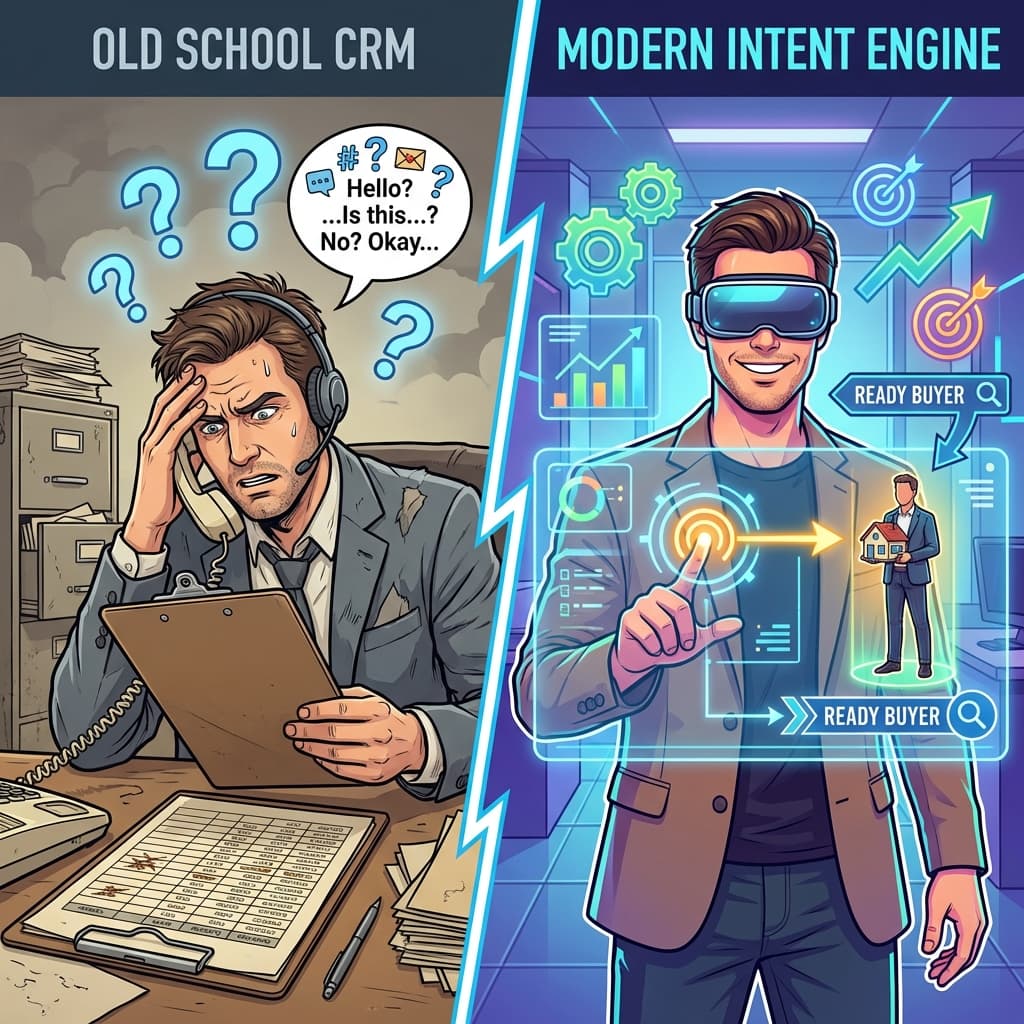
A sales head logged every call perfectly and still lost the deal, because her CRM recorded everything she did and nothing the buyer did. That blind spot is the Radar Gap, and it is why a filing cabinet will never tell you who is about to buy.
Sunita runs sales for a Pune developer. On the deal she lost last month, her CRM was immaculate: eight calls logged, three WhatsApp follow-ups, a brochure sent on the 4th, a site-visit invite on the 9th, every field filled. The buyer booked with a competitor on the 11th. When she opened the record to understand why, it told her everything her team had done and nothing about why the buyer chose someone else.
That is the whole problem in one screen. Her CRM recorded everything her team did. It recorded nothing the buyer did.
A CRM is a filing cabinet. It is an excellent record of your side of the conversation: tasks, calls, stages, notes. But the decision was not made on your side. It was made in the buyer’s side, the part you never see, and the distance between the two is the Radar Gap. A filing cabinet tells you what you filed. A radar tells you what is moving toward you. Most real estate teams are trying to fly on the filing cabinet.
What does a CRM actually record, and what does it miss?
A CRM is built to capture activity: who called, what was sent, which stage a lead sits in, when the next task is due. That is genuinely useful for managing your team. It is close to useless for reading the buyer, because the buyer’s evaluation happens somewhere your CRM has no sensor.
The scale of that blind spot is easy to underestimate. Gartner found that B2B buyers now spend only about 17 percent of their journey actually meeting suppliers; the other 80-odd percent is self-directed research no vendor sees. Real estate runs the same way. The buyer comparing your project does most of the work on portals, in family WhatsApp groups, and in late-night visits to the brochure you sent. Almost none of it reaches your CRM. Your filing cabinet is a careful record of the 17 percent and silent on the 80.
What is the Radar Gap?
The Radar Gap is the distance between what your CRM knows and what the buyer is actually doing. It is where Sunita lost her deal. The buyer who booked with the competitor had reopened the pricing page four times, shared the floor plan with two people, and come back to the payment-plan section at 11pm on Saturday. Her CRM showed none of that, so on Monday it ranked that lead the same as a tyre-kicker who had opened the brochure once and never returned.
Silence in a CRM reads as a cold lead. In the Radar Gap, that same silence can be the hottest buyer you have, evaluating hard and saying nothing. You cannot fix that with more follow-up calls, because the problem is not effort. It is that you are calling blind.
What does an intent engine see that a CRM cannot?
An intent engine is the radar. Where a CRM logs your actions, an intent engine watches the buyer’s behavior on the decision content you control: the microsite, the pricing page, the payment plan, the document pack, the booking link. It turns the invisible 80 percent into signal a rep can act on.
- Repeat visits to pricing or payment-plan pages inside a short window.
- The floor plan or brochure shared with new people, a sign a decision group is forming.
- Deep time on legal, possession, or availability sections, where serious buyers slow down.
- A return session within hours of a discovery call, the strongest readiness signal there is.
- Booking-link or financing clicks, intent you should never let sit until tomorrow.
A CRM tells you a rep logged three calls. An intent engine tells you the buyer revisited pricing four times in forty-eight hours and forwarded the plan to two contacts. One is a record of effort. The other is a reason to pick up the phone right now.
How do you close the Radar Gap on your team?
You do not replace the filing cabinet. You bolt a radar onto it. The CRM stays the system of record for what your team does; the intent engine becomes the system of signal for what the buyer does, and the two feed the same lead record so a rep sees both in one place.
- Put decision content on a tracked microsite, not a static PDF, so every view becomes a signal instead of a dead end.
- Route on behavior, not arrival order: a silent lead deep in pricing outranks a fresh lead who only saw photos.
- Trigger the call on the signal, not the calendar, so reps reach buyers inside the window that matters.
- Reference what the buyer actually looked at, so the follow-up sounds informed instead of generic.
The sequencing matters more than the tooling. Start with one project and one tracked microsite, wire the high-intent alerts into the channel your reps already watch, and agree on a single rule: any account that re-enters the pricing or payment-plan page twice in a day gets a call the same day. Once that one loop is working and the team trusts the signal, widen it to more projects and more signal types. Teams that try to instrument everything at once usually instrument nothing, because the alerts turn into noise no rep acts on, and the radar quietly becomes another dashboard nobody opens.
Rule Filing cabinet vs radar
A CRM records what your team did. An intent engine sees what the buyer is doing. You need both, but only one of them tells you who is about to buy.
What changes after a quarter
Teams that close the Radar Gap stop running pipeline reviews on activity counts and start running them on behavior. The Monday question changes from “how many calls did you make?” to “which buyers re-engaged this week, and did we reach them in time?” Reps stop wasting the morning on leads who only browsed photos, and high-intent buyers stop slipping to a competitor who simply called first. The CRM is still there, still useful, but it is no longer the only thing the team can see.
The deeper bet: read the buyer, not the rep
If Sunita could rerun that lost deal, no extra call would have saved it. What she needed was to see the buyer reopen the payment plan at 11pm on Saturday and to be on the phone Sunday morning, before the competitor was. The deeper shift in real estate sales is from measuring your team’s effort to reading the buyer’s intent, because the buyer was always going to decide in the 80 percent you could not see.
A CRM will always tell you what you did. The teams that win the next few years are the ones that also know what the buyer is doing, and act on it while it is still happening. Filing cabinets keep the past. Radar wins the present.
How much of your pipeline is hiding in the Radar Gap?
Brixi pairs your CRM with a buyer-intent engine, so every pricing revisit, microsite session, and share becomes a signal your reps can act on in time.
Explore the intent-powered CRMFrequently Asked Questions
A CRM records what your team did: calls, messages, stages, notes. An intent engine records what the buyer does: which pricing pages they revisit, what they share, how long they spend on legal or payment sections, when they come back. The CRM is your system of record; the intent engine is your system of signal. You need both, but only the intent engine tells you who is about to buy.
The Radar Gap is the distance between what your CRM knows and what the buyer is actually doing. Gartner found buyers spend only about 17 percent of their journey with suppliers and roughly 80 percent self-directed, so a CRM is a careful record of a small slice and silent on the decisive majority. In that gap, a lead who looks cold in your CRM can be the hottest buyer you have.
No. You keep the CRM as the system of record for your team’s activity and add an intent engine as the system of signal for buyer behavior. The two should feed the same lead record so a rep sees both the activity history and the live intent signals in one place, and routes and follows up on behavior rather than arrival order.
Repeat visits to pricing and payment-plan pages in a short window, the floor plan or brochure shared with new people, deep time on legal or possession sections, a return session within hours of a call, and booking-link or financing clicks. Clustered, recent signals matter far more than a single page open, and they should trigger an immediate call rather than a scheduled one.