Buyer Intent Signals Scorecard for Weekly Pipeline Reviews
A weekly scorecard built on buyer intent signals replaces gut-feel pipeline reviews with observable evidence. Learn how to build one, which signals to weight, and how to stop coaching reps on deals that were never close.
Kiran manages a real estate sales team of eleven reps in Thane. Every Monday morning he runs a pipeline review. He pulls up the CRM, scrolls through forty-odd deals, and asks each rep where things stand. The reps answer in confidence percentages. "That one is 80 percent." "This one just needs a follow-up call." By 9:45 the whiteboard is full of colored dots and Kiran still does not know which three deals will close this week.
The problem is not the reps. The problem is that the meeting is reviewing CRM fields instead of buyer behavior. Confidence language fills the room because there is no shared, observable evidence to replace it. The deals that close are the ones where the buyer was already deep in evaluation. The deals that slip are the ones where the rep was doing all the moving.
What is the Behavioral Evidence Gap in most pipeline reviews?
Pipeline reviews fail in a specific way. They surface activity on the seller side, calls made, messages sent, demos delivered, but they rarely surface activity on the buyer side. A lead who viewed the payment plan section of a personalized microsite at 11 pm on Sunday is showing more purchase intent than a lead who replied "sounds interesting" to a WhatsApp message three days ago. Without buyer intent tracking, those two deals look the same in the CRM.
The Behavioral Evidence Gap is the name for this problem. It is the distance between what the CRM records and what the buyer actually did. In most teams, that gap is wide. Reps log calls and notes. They do not log that the buyer returned to the pricing page twice after the site visit, forwarded the proposal to a second contact, or spent nine minutes on the legal terms section. Those are the signals that matter for qualification.
Closing the Behavioral Evidence Gap is not about adding more fields to the CRM. It is about routing observable buyer behavior into the weekly review so the conversation can move from "how confident are you" to "what did the buyer do this week."
Which buyer intent signals actually predict deal movement?
Not all engagement is equal. A lead opening a brochure PDF once is weak signal. A lead returning to a personalized sales page three times in two days, navigating from the floor plan to the payment structure, is strong signal. The difference is depth and sequence.
In deployments we see, the signals that correlate most consistently with near-term closes share three properties: they are decision-oriented rather than discovery-oriented, they are recent rather than historical, and they show progression rather than repetition of the same action. A buyer who reads the overview section five times is not more serious than a buyer who read the overview once, then the pricing once, then came back to the payment schedule.
- Return visits to pricing or payment terms within 48 hours of a sales conversation.
- Navigation from product overview to commercial detail within a single session.
- Content forwarding or link sharing that suggests a second stakeholder is reviewing.
- Engagement on objection-related sections immediately before the next scheduled call.
- Time spent on legal or agreement language, which is late-stage evaluation behavior.
- Repeat microsite sessions from a new device, often indicating a decision-maker has been looped in.
- Drop-off on specific sections that flags a concern the rep has not yet addressed.
The anti-pattern here is treating reply speed as a proxy for intent. A lead who responds quickly to every message but never engages with decision-stage content is not a serious buyer. They may be polite, curious, or bored. Reply speed measures the buyer's communication style, not their evaluation progress. Teams that use reply speed as a primary lead qualification signal consistently overestimate their pipeline.
How do you build a scorecard that reps will actually use?
A scorecard is useful only if it produces a clear action. If the score sits in a dashboard but does not change what the rep does next, it is decoration. The design principle is: every score band maps to a specific next action, not a general recommendation.
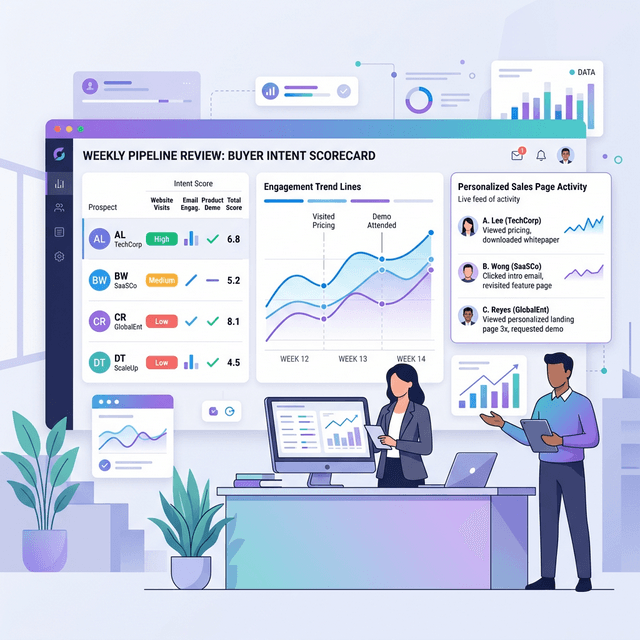
Start with three bands. High intent means the buyer has shown decision-stage engagement in the last 72 hours. The action is a same-day call from the closest. Medium intent means the buyer has shown engagement but not at decision depth, or engagement that is more than five days old. The action is a contextual follow-up referencing what the buyer actually viewed. Low intent means no substantive engagement in the last ten days. The action is a structured nurture sequence, not a rep call.
The hardest part is recency weighting. Most teams score a lead once and forget that the score decays. A buyer who was high intent three weeks ago and has been silent since is not high intent today. Build a decay rule into your scorecard: engagement older than seven days should reduce the score, not preserve it. This single change usually cuts phantom pipeline by 20 to 30 percent in the first month.
What does a scored pipeline review actually look like in practice?
Kiran runs the same Monday review, but now every deal comes into the room with a score derived from buyer behavior in the prior seven days. The format changes. Instead of "where does this stand," the question becomes "what did this buyer do last week and what does that mean for our next move."
Deal A has a score of 84. The buyer visited the payment plan section twice on Friday evening, then forwarded the microsite link to a second contact on Saturday. The rep did not know about the Saturday visit. Kiran adjusts the plan: call today, reference the payment discussion, ask who else is involved in the decision.
Deal B has been sitting at the same CRM stage for three weeks with a rep confidence rating of 75 percent. The scorecard shows no engagement in 18 days. The rep says the buyer is "still thinking." Kiran moves it to nurture, freeing that rep slot for Deal C, which scored 71 after a first-time visit to the legal terms page yesterday.
The central contrast
Confidence language in pipeline reviews measures how the rep feels about the deal. Buyer intent signals measure what the buyer actually did. Only one of those inputs predicts outcomes.
The review takes the same 45 minutes. But the decisions that come out of it are anchored to evidence. Reps stop defending stale deals because the scorecard shows the decay. Managers stop guessing about forecasts because the data shows which deals have live buyer activity.
Which anti-patterns should you eliminate before building the scorecard?
Most teams carry at least two or three scoring anti-patterns that will corrupt the scorecard if not addressed first. The most common ones are predictable.
- Counting all page visits equally: a buyer reading the "about us" page is not equivalent to reading the payment terms. Weight content type, not just visit count.
- Using first-touch attribution for score: a high-intent visit in week one should not carry the same weight in week four. Score is a function of recency and depth together.
- Letting reps manually override scores without logging a reason: overrides without documentation erode scorecard trust within a few cycles.
- Including deals with no shared microsite or tracked content: if you cannot see the buyer's behavior, you cannot score them. Pushing untracked deals into a scored pipeline creates false precision.
- Running the review quarterly instead of weekly: intent signals decay fast. A once-a-month review of buyer behavior is almost useless for near-term forecasting.
There is a contrarian claim worth sitting with: a well-built intent scorecard will initially shrink your apparent pipeline. Deals that looked alive will score low and move to nurture. This feels bad in week one. By week six, the forecast becomes dramatically more reliable and coaching time stops going to deals that were never moving.
How do personalized microsites improve intent signal quality?
When sales collateral is scattered across WhatsApp, email attachments, Google Drive links, and PDFs, buyer behavior becomes invisible. You can see that the email was opened. You cannot see which section the buyer spent time on, whether they came back, or who else they shared it with.
Personalized microsites consolidate the buyer journey into a single tracked environment. The buyer receives one link. Inside it, they find the floor plan, payment schedule, site walkthrough, legal summary, and a way to ask questions. Every action inside that environment generates a buyer intent signal. Return visits are recorded. Section depth is recorded. Sharing events are recorded.
For teams running weekly pipeline reviews, this is the infrastructure shift that makes the scorecard possible. Without a concentrated tracking environment, behavior is too fragmented to score reliably. With it, the Behavioral Evidence Gap narrows to the point where scores actually reflect what the buyer is doing.
What changes after a quarter of running scored pipeline reviews?
After about twelve weeks, teams that commit to a behavior-based scorecard consistently see three changes.
First, forecast accuracy improves. Deals that score high in the prior week close at a meaningfully higher rate than deals in the same stage without high-intent signals. The correlation tightens over time as teams calibrate which signals in their specific context are most predictive.
Second, rep coaching changes character. Managers stop coaching on pipeline confidence and start coaching on behavior-based conversation skills. "The buyer spent time on the payment structure but has not asked about it. How are you planning to open that in the next call?" That is a specific, coachable moment. "Why is your close rate low?" is not.
Third, lead response strategy improves. Teams realize that high-intent signals arriving outside business hours are often more important than low-intent signals arriving during them. They build response rules around signal type and recency rather than queue position. In real estate teams, this alone recovers several deals per quarter that would have gone cold from slow response.
- Weekly scorecard review replaces the confidence-language standup with a behavior-evidence discussion.
- Coaching sessions reference specific buyer actions rather than general deal health.
- Nurture tracks are populated with data rather than rep intuition.
- Response SLAs are differentiated by intent score, not by lead source or deal size.
- Forecast calls use signal trends from the prior three weeks as the primary input.
What is the deeper bet Kiran is actually making?
Kiran is not just changing how he runs a Monday meeting. He is making a structural bet: that the teams who understand buyer behavior before their competitors do will win the deal even when the product and price are comparable.
In a category like residential real estate in Thane, where a dozen developers are selling broadly similar inventory in overlapping price bands, the buying decision is less about product differentiation and more about which sales team makes the buyer feel seen and understood at the moment they are ready to move. A rep who calls the day after the buyer spent 14 minutes on the payment schedule and leads with "I noticed you were looking at the payment structure, let me answer the questions I imagine came up" is operating on a different level than a rep running a fixed cadence.
The Behavioral Evidence Gap is ultimately a competitive gap. Teams that close it do not just forecast better. They have better conversations, earn faster trust, and lose fewer deals to competitors who caught the buyer at the right moment by accident. Closing it intentionally, with a scored pipeline review built on real buyer intent signals, is how a sales manager turns a Monday meeting into a competitive advantage.
Ready to run your next pipeline review on buyer evidence?
Brixi tracks buyer intent signals across personalized microsites, WhatsApp, and voice conversations so your weekly review is built on what buyers actually did.
Explore the Buyer Intent EngineFrequently asked questions
What are buyer intent signals and how are they different from lead activity?
Lead activity covers everything a prospect does, including opening emails, clicking links, and attending demos. Buyer intent signals are a subset of that activity: the specific behaviors that indicate a prospect is moving toward a purchase decision rather than just gathering information. Returning to a pricing page, spending time on legal terms, or forwarding a proposal link to a colleague are intent signals. Opening a newsletter is activity. The difference matters because intent signals are the ones worth routing to your best reps immediately.
How do I know if a lead is serious without asking them directly?
The most reliable way to know if a lead is serious without asking is to observe whether they are consuming decision-stage content. Serious buyers move from overview material to commercial detail. They return to specific sections rather than browsing broadly. They engage at unusual hours, evenings and weekends, when the consideration is personal rather than casual. They share content with others, suggesting internal consensus-building. When those patterns appear together, the lead is self-qualifying through their behavior.
How often should I update the buyer intent scorecard scoring rules?
Calibrate scoring rules every four to six weeks for the first six months, then quarterly once the signal-to-outcome correlation is stable. The most common calibration needed is adjusting recency windows. Teams frequently start with a seven-day recency window and find that in their specific deal cycle, three-day recency is far more predictive. Compare scores from four weeks prior against the actual deal outcomes that followed. The signals that most consistently preceded closes should gain weight. The signals that were present in stalled deals should lose it.
Can a buyer intent signals scorecard work without a personalized microsite tool?
It can work partially. Email open tracking, proposal view time, and CRM engagement logs all generate some buyer intent data. The limitation is fragmentation: when buyer behavior is spread across four or five channels, it is hard to reconstruct a coherent picture of what the buyer did and in what sequence. Personalized microsites consolidate that behavior into a single environment, which makes signal quality substantially higher. Teams running scored reviews without consolidated tracking will see benefits, but they will miss a significant portion of the behavior that matters most.
Frequently Asked Questions
Lead activity covers everything a prospect does, including opening emails, clicking links, and attending demos. Buyer intent signals are a subset of that activity: the specific behaviors that indicate a prospect is moving toward a purchase decision rather than just gathering information. Returning to a pricing page, spending time on legal terms, or forwarding a proposal link to a colleague are intent signals. Opening a newsletter is activity. The difference matters because intent signals are the ones worth routing to your best reps immediately.
The most reliable way to know if a lead is serious without asking is to observe whether they are consuming decision-stage content. Serious buyers move from overview material to commercial detail, return to specific sections rather than browsing broadly, and engage at unusual hours when the consideration is personal. They also share content with others, suggesting internal consensus-building. When those patterns appear together, the lead is self-qualifying through their behavior.
Calibrate scoring rules every four to six weeks for the first six months, then quarterly once the signal-to-outcome correlation is stable. The most common calibration needed is adjusting recency windows, since teams frequently find that three-day recency is far more predictive than a seven-day window. Compare scores from four weeks prior against actual deal outcomes, giving more weight to signals that consistently preceded closes and less to signals present in stalled deals.
It can work partially, using email open tracking, proposal view time, and CRM engagement logs. The limitation is fragmentation: when buyer behavior is spread across multiple channels, it is hard to reconstruct a coherent picture of what the buyer did and in what sequence. Personalized microsites consolidate that behavior into a single tracked environment, which makes signal quality substantially higher and narrows the Behavioral Evidence Gap.